Curcumin Extraction Plant
Part of the Kadali Africa Ventures catalogue. Send your raw material, target product and capacity for a technical proposal. Request a quote →
Product Categories
- Herbal, Botanical & Nutraceutical Extraction(9)
- Essential Oils, Spices & Oleoresins(6)
- Fruit & Vegetable Processing(8)
- Starch, Flour, Edible Oil & Food Processing(7)
- Drying & Dehydration Systems(5)
- Evaporation, Concentration & Solvent Recovery(4)
- Pharmaceutical & Industrial Process Equipment(4)
- Cocoa, Shea, Palm Oil & Oilseed Processing(6)
- Cereals, Tubers & Sugar Processing(6)
- Specialty African Botanical & Natural Ingredients(11)
- Specialty Food, Beverage & By-Product Processing(7)
Talk to Kadali Africa Ventures
Send your raw material, product and capacity for a technical proposal.
Contact Kadali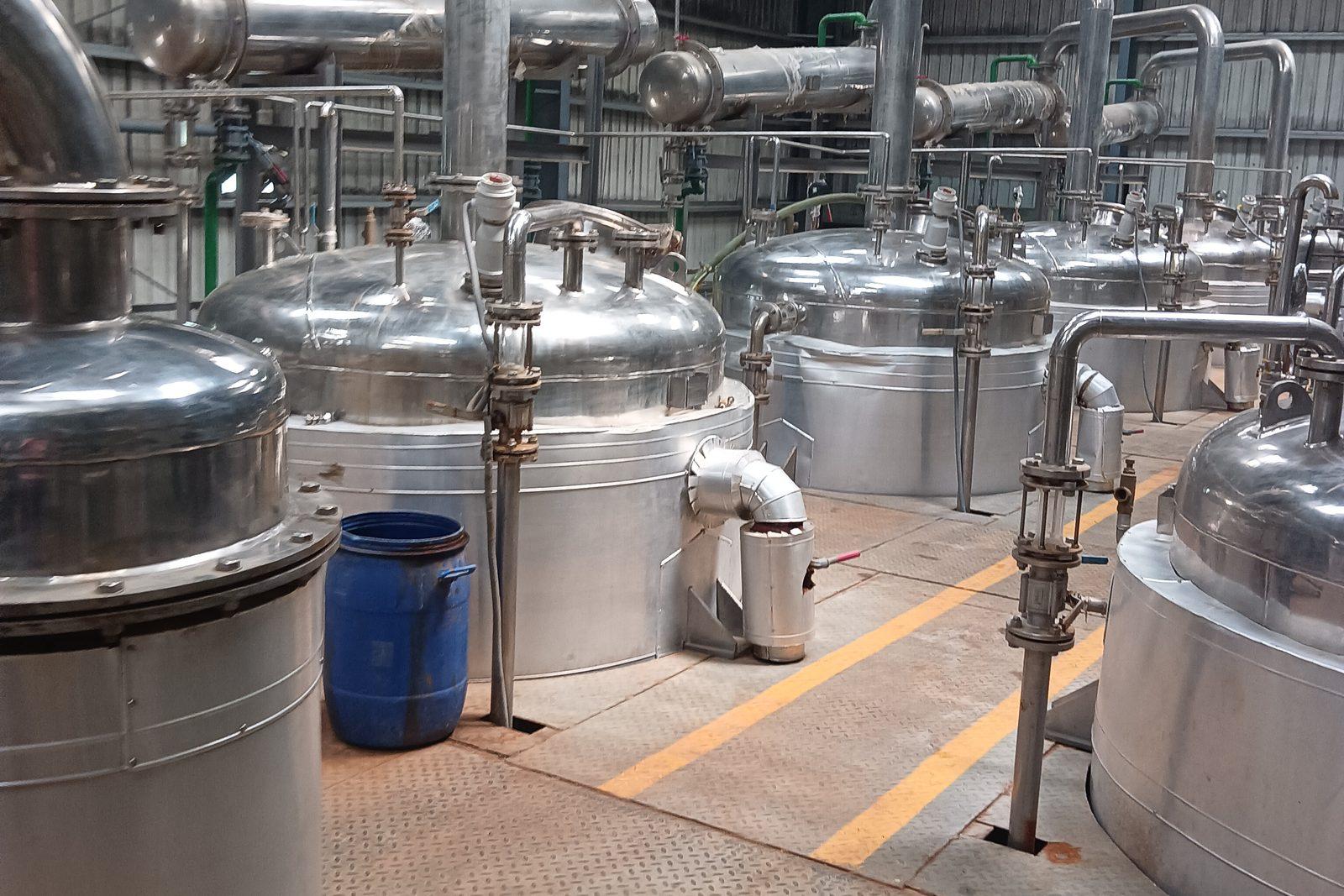
Curcumin Extraction Plant
This plant suits processors who hold, or can secure, turmeric (Curcuma longa) rhizome and want to sell a curcuminoid ingredient instead of fingers or ground spice. The first things to settle are the form of the rhizome you will receive (whole, sliced or milled), its moisture, and the end market for the extract. A food-colour buyer, a nutraceutical brand and a pharmaceutical manufacturer ask for different solvents and residue limits, and that choice shapes the whole plant. The second decision is the product: crystallised curcuminoid powder is the line described here, while nano curcumin, tetrahydrocurcumin and turmeric oil are neighbouring routes that each have their own page.
The curcuminoid line is listed as a closed-loop sequence. Rhizome is cleaned and hammer-milled, then extracted in jacketed SS 316L tanks. The extract is clarified on a plate-and-frame filter press and centrifugal separator with cartridge polish filters, concentrated in a falling-film / vacuum concentrator, and the solvent is recovered. A purification step precedes crystallisation, the crystals are separated in industrial centrifuges, and a spray or vacuum dryer, pulveriser and blender finish the powder. CIP and PLC-SCADA automation complete the scope. Curcuminoids are chemically unstable and sensitive to pH, temperature and light, and curcumin also undergoes autoxidation, so extraction and concentration are held at controlled temperature and the extract stays in closed handling. Ethanol, acetone or hydro-alcoholic blends are selected against the target grade, because the solvent also decides how well the crystallisation step works. Configuration follows raw material, product target and capacity.
Indicative Capacity Range
- 100–5,000 kg feed/day
Key Specification Inputs
Extraction solvent/water, extraction stages, batch time, filtration and recovery.
Technical Specifications
| Plant type | Solvent extraction of curcuminoids from turmeric, completed by crystallisation |
|---|---|
| Feedstock | Turmeric (Curcuma longa) rhizome; form and moisture agreed per project |
| Target compounds | Curcuminoids and turmerones |
| Grade range | A configurable range is listed on the product page and reaches up to 95% Curcuminoids by HPLC; other specifications can be discussed |
| Solvents and vessels | Ethanol, acetone or hydro-alcoholic blends handled in a closed loop, in jacketed SS 316L tanks |
| Technologies screened | Seven candidates are screened on the product page: counter-current, supercritical CO2, subcritical water, ultrasound-assisted, enzyme-assisted, hybrid and microwave-assisted |
| Clarification and concentration | Filter press, centrifugal separator and cartridge polish filters, then a falling-film / vacuum concentrator that sends solvent to recovery |
| Isolation | Purification, then crystallisers and industrial centrifuges |
| Drying | Spray dryer or vacuum dryer, chosen to suit the product |
| Contact surfaces | SS 316L, electropolished and cleaned in place |
| Controls | Manual, semi-automatic or full PLC-SCADA, set per project |
| Plant capacity | Set per project from feed supply, target product |
Typical Process Route
Intake and Preparation
Incoming rhizome is authenticated by curcuminoid assay, cleaned, then milled to an even particle size so that solvent can reach the pigment-bearing tissue.
Extraction
Milled turmeric is held in sealed, jacketed SS 316L tanks with controlled temperature and stirring. The solvent is picked for the target grade (ethanol, acetone or a hydro-alcoholic blend), since food and pharmaceutical specifications set different solvent and residue limits.
Clarification
The miscella passes through a filter press and centrifugal separator, then cartridge polish filters, which strip out fines and fibre.
Concentration and Solvent Return
A falling-film / vacuum concentrator removes most of the solvent. Condensed solvent goes back through the recovery circuit for reuse.
Purification
Colour bodies, resin and unwanted plant constituents are reduced before the concentrate is sent on to crystallisation.
Crystallisation and Separation
Crystallisers run at a controlled temperature, cooling rate and residence time. Industrial centrifuges lift the crystals out, and the mother liquor returns to solvent recovery.
Assay and Standardisation
Crystals are assayed by HPLC and brought to the declared curcuminoid specification before drying. Release depends on assay, residual-solvent, heavy-metal, microbial and moisture results.
Drying and Finishing
The standardised extract is spray- or vacuum-dried to a free-flowing powder, then pulverised and blended for encapsulation, formulation or bulk packing.
Major Plant Equipment
- Cleaning line and hammer mill for the rhizome
- Jacketed stainless-steel extraction tanks
- Solvent storage tanks and extraction pumps
- Pressure leaf filters and plate-and-frame filter press
- Centrifugal separator
- Falling-film / vacuum evaporator
- Multi-stage condensers
- Crystallisers
- Industrial centrifuges
- Spray dryer or vacuum tray dryer
- Pulveriser and blending system
- Solvent recovery unit
- Clean-in-place (CIP) skid
- PLC-SCADA controls, electrical MCC and instruments
Plant Output
Applications
- Standardised curcuminoid ingredient for pharmaceutical manufacturers
- Capsule, tablet and supplement production for nutraceutical brands
- Natural colour and flavour uses in food
- Active ingredient for cosmetic and personal care formulators
- Herbal and traditional-medicine preparations
- Feed material for nano curcumin and tetrahydrocurcumin ingredients (separate plant pages)
Key Features
Route Choice Made Explicit
Curcuminoids by solvent extraction and crystallisation, nano curcumin by an added particle-size stage, tetrahydrocurcumin by catalytic hydrogenation and turmeric oil by distillation or CO2 are kept as separate routes, so the plant matches the product you intend to sell.
Crystallisation Stage
Purpose-built crystallisers and centrifuges isolate curcumin crystals, and the mother liquor is returned to the solvent-recovery circuit.
Closed Solvent Loop
Condensers and a recovery unit return solvent to the process. How much is recovered is settled during process development.
Assay-Led Release
HPLC assay is used in process and at batch release to compare the extract with the declared curcuminoid specification.
Other Extraction Methods Can Be Scoped
Where a project calls for supercritical CO2, ultrasound or microwave extraction, these can be assessed at the design stage.
Related Products
Frequently Asked Questions
Which turmeric product should a processor make first?
How do nano curcumin and tetrahydrocurcumin differ from standard curcumin?
How do I choose between ethanol, acetone and a hydro-alcoholic blend?
How should turmeric be prepared and stored in hot, humid conditions?
What drives solvent and energy use in a curcumin plant?
What should I prepare before extraction trials?
Can extraction use CO2, ultrasound or microwave instead of solvent?
What decides the price of a curcumin plant?
What should I include when I ask for a curcumin plant proposal?
Ready to discuss your project?
Call or email Kadali Africa Ventures with your raw material, target product and capacity.