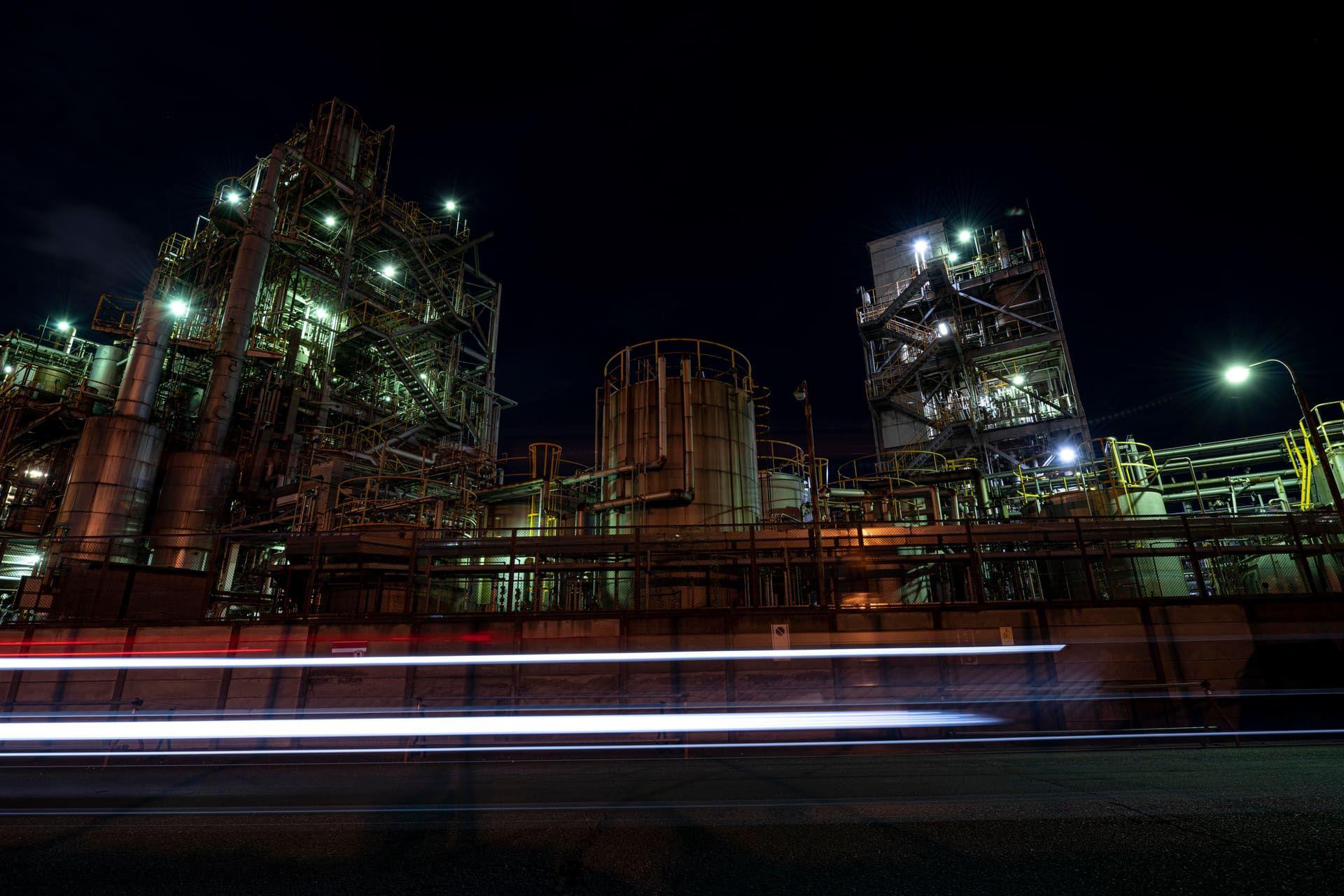
Vacuum Evaporator
Part of the Kadali Africa Ventures catalogue. Send your raw material, target product and capacity for a technical proposal. Request a quote →
Product Categories
- Herbal, Botanical & Nutraceutical Extraction(9)
- Essential Oils, Spices & Oleoresins(6)
- Fruit & Vegetable Processing(8)
- Starch, Flour, Edible Oil & Food Processing(7)
- Drying & Dehydration Systems(5)
- Evaporation, Concentration & Solvent Recovery(4)
- Pharmaceutical & Industrial Process Equipment(4)
- Cocoa, Shea, Palm Oil & Oilseed Processing(6)
- Cereals, Tubers & Sugar Processing(6)
- Specialty African Botanical & Natural Ingredients(11)
- Specialty Food, Beverage & By-Product Processing(7)
Talk to Kadali Africa Ventures
Send your raw material, product and capacity for a technical proposal.
Contact Kadali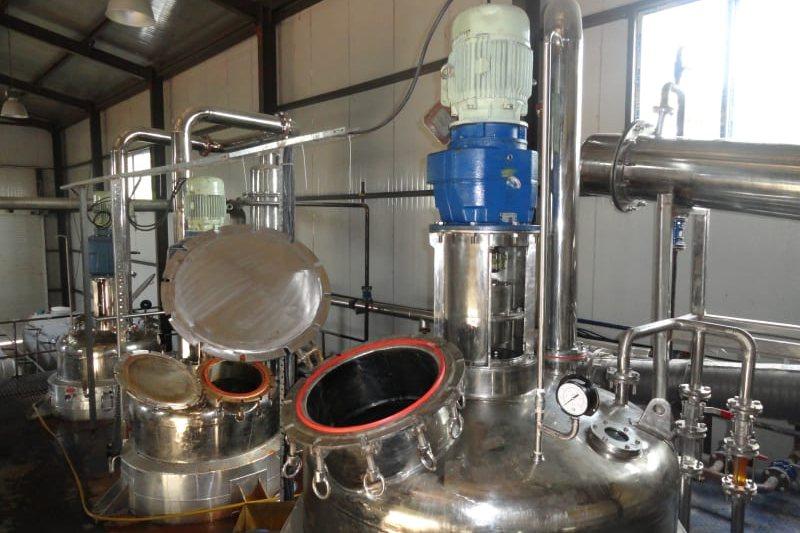
Vacuum Evaporator
A vacuum evaporator is the practical starting point for a processor who needs to concentrate a heat-sensitive liquid in modest, changing batches: botanical extracts, fruit or flavour concentrates, and pharmaceutical or nutraceutical liquids. It is a single jacketed, agitated vessel run under reduced pressure, so the liquid boils at a lower temperature than it would in the open. Four things need to be decided before it can be sized: the batch volume and how many batches a day, the solids in the feed and the final solids or Brix wanted, how much heat the product can take, and which heat source and vacuum utility the site can support. It is not a continuous or high-capacity machine; where volumes are large, where the liquid fouls heavily or where steam economy dominates, a film, forced-circulation or multiple-effect arrangement is the better fit. The evaporator is listed as a complete vessel, condenser, vacuum and control package for such batch duties.
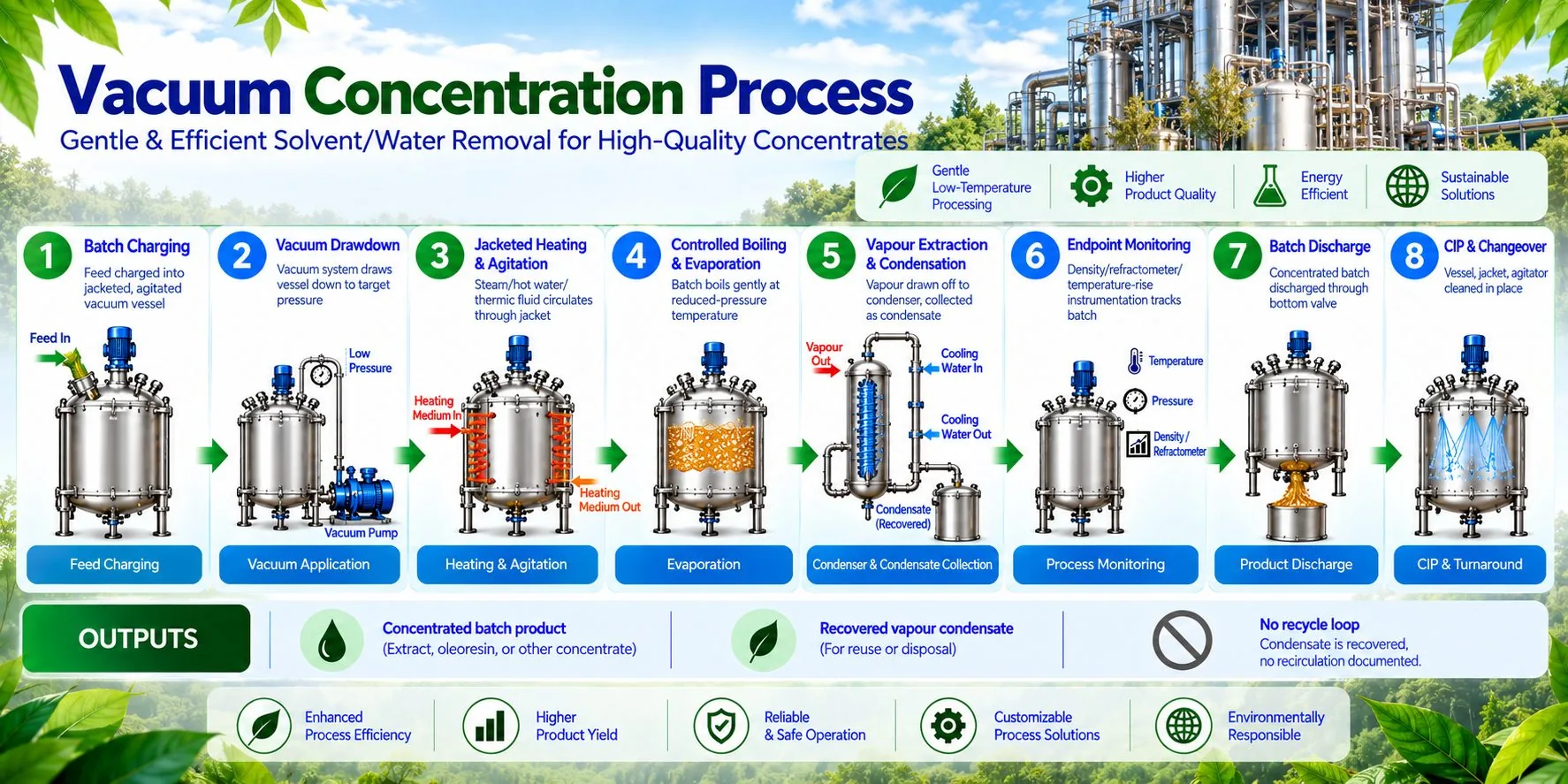
Feed is loaded into a jacketed vessel with an agitator. The vacuum system lowers the pressure to the chosen set point, so the liquid boils at a correspondingly lower temperature, while steam, hot water or thermic fluid in the jacket supplies gentle heat. The agitator keeps the batch moving against the heated wall, which helps limit burn-on and uneven concentration; Boiling under vacuum at about 60-70 °C, depending on the degree of vacuum, gives fruit products better taste and flavour retention. Vapour leaves through a demister to a condenser and is collected as condensate. The batch is held under vacuum and agitation until density, refractometer or temperature readings show that the target concentration or solids has been reached. Because a single vessel has no fixed film or circulation geometry, changing from one product to the next is simple and cleaning in place between batches is straightforward, which suits multi-product work and trial programmes. The price of that flexibility is running cost: a batch vessel makes no attempt to reuse vapour heat, so energy use per kilogram of water removed is higher than in a multi-effect train, which passes vapour heat from stage to stage. The vessel, jacket, agitator and vacuum equipment are in SS 316L or another suitable grade, with CIP connections and PLC-based instrumentation. Volume and vacuum rating follow the batch size and the product.
Key Specification Inputs
Feed solids, final Brix, product sensitivity and energy.
Process Flow
Technical Specifications
| Evaporator Type | Vacuum evaporator: a general-purpose agitated vessel |
|---|---|
| Working Principle | Lower vessel pressure reduces the boiling point, so the batch is concentrated at low temperature with gentle jacket heat |
| Vessel | Jacketed and agitated, for batch or semi-continuous operation |
| Agitation | Motor-driven agitator; type and speed matched to product viscosity |
| Heating Medium | Steam, hot water or thermic fluid in the jacket, as configured |
| Operating Mode | Under vacuum, for low-temperature concentration of heat-sensitive product |
| Suitable Duty | General batch concentration of smaller volumes, with frequent product changes |
| Contact Material | SS 316L, or another grade suited to the product |
| Condensing System | Surface or barometric condenser with vacuum ejector or pump |
| Automation | PLC control of temperature, vacuum and batch endpoint; SCADA can be configured |
| Cleaning | Product-contact circuit arranged for clean-in-place |
| Batch Flexibility | Handles different products and varying batch sizes in the same vessel |
| Capacity | Sized to the requirement, from pilot scale to mid-scale batch duty |
| Utilities | Steam, hot water or thermic fluid for the jacket; cooling water, vacuum utilities, electric power and compressed air |
Plant Capacities
| Scale | Typical Batch Size | Vessel Configuration | Typical Duty |
|---|---|---|---|
| Pilot / R&D | Small batch | Single jacketed agitated vessel | Formulation and process development |
| Small commercial | Mid-size batch | Sized jacketed vessel with agitator | General batch concentration, flexible product mix |
| Mid-scale commercial | Larger batch or semi-continuous | Larger jacketed vessel, upgraded vacuum system | Higher-volume general-purpose evaporation |
Vessel volume, agitator duty and vacuum system follow from the batch size, product viscosity and heat sensitivity. For continuous, high-throughput or strongly fouling duty, a film, forced-circulation or multi-effect evaporator is normally the better fit.
Typical Process Route
Define Batch, Solids and Endpoint
Batch volume, feed solids, final Brix or solids, heat limits and the cleaning routine between products are fixed first, since they set vessel size, jacket area and vacuum capacity.
Loading the Vessel
The feed goes into the jacketed, agitated vessel, either as a single charge or in stages when the operation is run semi-continuously.
Drawing the Vacuum
The vacuum system takes the vessel down to the operating pressure, which lowers the temperature at which the liquid will boil before heating starts.
Heating and Mixing
Steam, hot water or thermic fluid flows through the jacket and the agitator keeps the batch moving, spreading heat evenly and limiting burn-on at the wall.
Gentle Boiling
The batch boils at the lowered temperature, releasing water or solvent while stirring keeps the concentration uniform.
Removing and Condensing Vapour
Vapour is pulled off through a demister to the condenser and collected as condensate, which may be reused or disposed of according to its quality.
Watching the Endpoint
Density, refractometer or temperature-rise instruments follow the batch towards the target concentration, moisture or solids.
Discharging the Batch
At the endpoint the concentrate leaves through the bottom valve to storage or to the next stage, for example drying.
Cleaning and Changeover
Vessel, jacket and agitator are cleaned in place between batches or products, so one unit can serve several products. Low-temperature vacuum evaporation can let bacteria multiply in the equipment, so cleaning is frequent and a sanitising step is planned.
Major Plant Equipment
- Jacketed, agitated evaporator vessel
- Agitator motor and gearbox
- Jacket supply for steam, hot water or thermic fluid
- Vapour outlet with demister
- Surface or barometric condenser
- Vacuum system, using a steam ejector or liquid-ring pump
- Condensate receiver and pump
- Bottom discharge valve and pump
- Density or refractometer and temperature instruments
- CIP skid with spray-ball connections
- Temperature and vacuum or pressure transmitters
- PLC control panel with motor control centre
Plant Output
Applications
- Batch concentration of pharmaceutical and nutraceutical liquids
- Low-temperature pre-concentration of heat-sensitive extracts
- Small and medium batches of food and flavour concentrates
- Contract work with frequent product changes
- Trial and pilot concentration before scale-up
- Recovering solvent from small-volume process residues
- Pre-concentrating botanical extracts before drying or crystallisation
- Thickening viscous formulations under vacuum
Key Features
One Vessel, Many Products
A single agitated, vacuum-rated vessel takes varied batch sizes and product changes without the fixed geometry of a film or forced-circulation body.
Low-Temperature Concentration
Operating under vacuum lowers the boiling point, so heat-sensitive liquids avoid the thermal stress of boiling at atmospheric pressure.
Even Heating through Agitation
Stirring continuously moves liquid across the jacketed wall, which helps limit burn-on and gives a more uniform concentration.
Simple Cleaning and Changeover
A single vessel with clean-in-place connections makes switching between products quick and repeatable.
Sized for Small and Pilot Duty
It fits smaller batches and development programmes, and a move to a film, forced-circulation or multi-effect unit is possible as volumes grow.
Related Products
Frequently Asked Questions
Who is a vacuum evaporator for, and what should be settled first?
How does it work?
How does it differ from a falling-film or multiple-effect evaporator?
What does running it cost in energy?
Which products suit it?
Can it be used for trials before a larger plant is built?
How should a feed be prepared in a warm climate?
What should be prepared for a technical proposal?
What does the listed system include?
Ready to discuss your project?
Call or email Kadali Africa Ventures with your raw material, target product and capacity.