Essential Oil Distillation Plants
Part of the Kadali Africa Ventures catalogue. Send your raw material, target product and capacity for a technical proposal. Request a quote →
Product Categories
- Herbal, Botanical & Nutraceutical Extraction(9)
- Essential Oils, Spices & Oleoresins(6)
- Fruit & Vegetable Processing(8)
- Starch, Flour, Edible Oil & Food Processing(7)
- Drying & Dehydration Systems(5)
- Evaporation, Concentration & Solvent Recovery(4)
- Pharmaceutical & Industrial Process Equipment(4)
- Cocoa, Shea, Palm Oil & Oilseed Processing(6)
- Cereals, Tubers & Sugar Processing(6)
- Specialty African Botanical & Natural Ingredients(11)
- Specialty Food, Beverage & By-Product Processing(7)
Talk to Kadali Africa Ventures
Send your raw material, product and capacity for a technical proposal.
Contact Kadali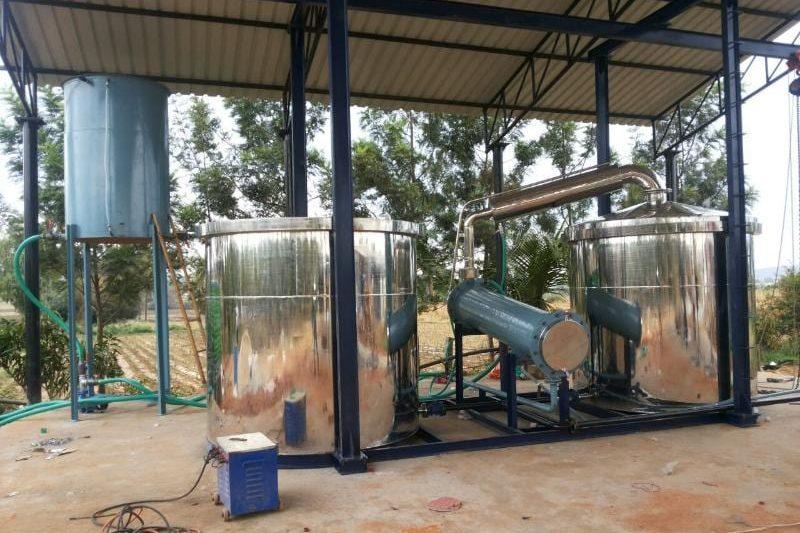
Essential Oil Distillation Plants
An essential oil plant is sized by what is put in the still and what is wanted out. The processor has to decide which aromatic crop is distilled (leaf, flower, bark, root, seed or peel), whether it arrives fresh, wilted or dried, how much goes into each batch, and which oil quality the buyer will test for. Lemongrass, eucalyptus, clove, geranium and ylang-ylang are examples of distilled crops. Steam, hydro, vacuum and pressure distillation, and cold-press extraction for citrus peel, are the routes covered here, all for commercial output rather than small-batch use.
The route is chosen from how the oil behaves: how volatile it is, how well it tolerates heat and how the crop packs in the still. The plant couples the still to a condenser and a stainless-steel Florentine flask that separates oil from hydrosol. Steam can come from a boiler burning local fuel such as wood or crop residue, and the spent plant material is often used as boiler fuel too. Wetted parts are SS 316L, with PLC-based automation and clean-in-place washing between batches, which matters when one still handles several crops in turn. Supply scope, including whether the plant is commissioned as a turnkey system, is set in the technical proposal.
Indicative Capacity Range
- 250–5,000 kg botanical/batch
Key Specification Inputs
Steam rate, oil yield assay, condenser duty, oil-water separation.
Typical Process Route
Preparing the crop
Material is cleaned, sorted and, where the crop calls for it, chopped or crushed to a size that lets oil escape without packing the still. How the crop is dried and stored after harvest changes oil yield and composition, so the handling routine is settled crop by crop.
Loading and distilling, or cold pressing
The charge goes into the SS 316L still and is distilled with steam, in water, under vacuum or under pressure. Oil-rich peel, such as citrus, can instead be cold pressed rather than distilled.
Condensing
Vapour from the still passes to the condenser, where the volatile oil and water vapour become liquid together. The condenser duty sets how fully the oil is captured.
Separating oil from hydrosol
Condensate runs into a stainless-steel Florentine flask. The oil separates from the water because the two differ in density, so the oil is drawn off, and the water phase, the hydrosol, can be kept as a co-product.
Polishing and drying
The crude oil is filtered to remove particles and dried to remove entrained water before storage.
Testing and records
Each batch is checked against agreed physical and analytical parameters, and batch records are kept before the oil is released.
Major Plant Equipment
- Crop cleaning and chopping unit
- SS 316L still (steam, hydro, vacuum or pressure mode)
- Steam boiler or steam supply connection
- Condenser with cooling-water circuit
- Stainless-steel Florentine flask (oil-water separator)
- Hydrosol collection tank
- Oil polishing filter and drying unit
- Cold-press extractor (citrus peel route)
- Oil storage vessels
- PLC panel, electrical MCC and instruments
Plant Output
Applications
- Aromatherapy and massage oils
- Fragrance and perfumery compounds
- Flavour oils for food and beverages
- Cosmetic and personal-care formulations
- Hydrosols (aromatic waters) sold as a co-product
- Oil supply to pharmaceutical and nutraceutical formulators
Key Features
Stainless-steel contact surfaces
SS 316L wetted parts resist corrosion and protect oil purity, with clean-in-place washing between batches.
Condensing and Florentine separation
A well-sized condenser and a stainless-steel Florentine flask capture the oil and keep it apart from the hydrosol.
Route chosen for the crop
Steam, hydro, vacuum, pressure or cold-press operation is selected for the feedstock and the oil in question.
Hydrosol as a co-product
Separated aromatic water can be collected and sold or reused rather than lost.
Controls and clean build
PLC-based automation and hygienic design support repeatable batches with records.
Country Pages for Essential Oil Distillation Plants
This product is listed on the pages of the countries below, each with its own enquiry route. Where Kadali has no office in a country, enquiries are handled from the Accra office.
Related Products
Frequently Asked Questions
What should I decide before choosing an essential oil distillation plant?
How do steam and hydro distillation differ?
Why can oil yield differ between batches of the same crop?
How should crops be handled before distillation in tropical conditions?
Is cold pressing a better choice for citrus peel?
What is the difference between an essential oil plant and an oleoresin plant?
Should I choose a batch or a continuous plant?
What should I send for a technical proposal?
What does an essential oil distillation plant cost?
Ready to discuss your project?
Call or email Kadali Africa Ventures with your raw material, target product and capacity.