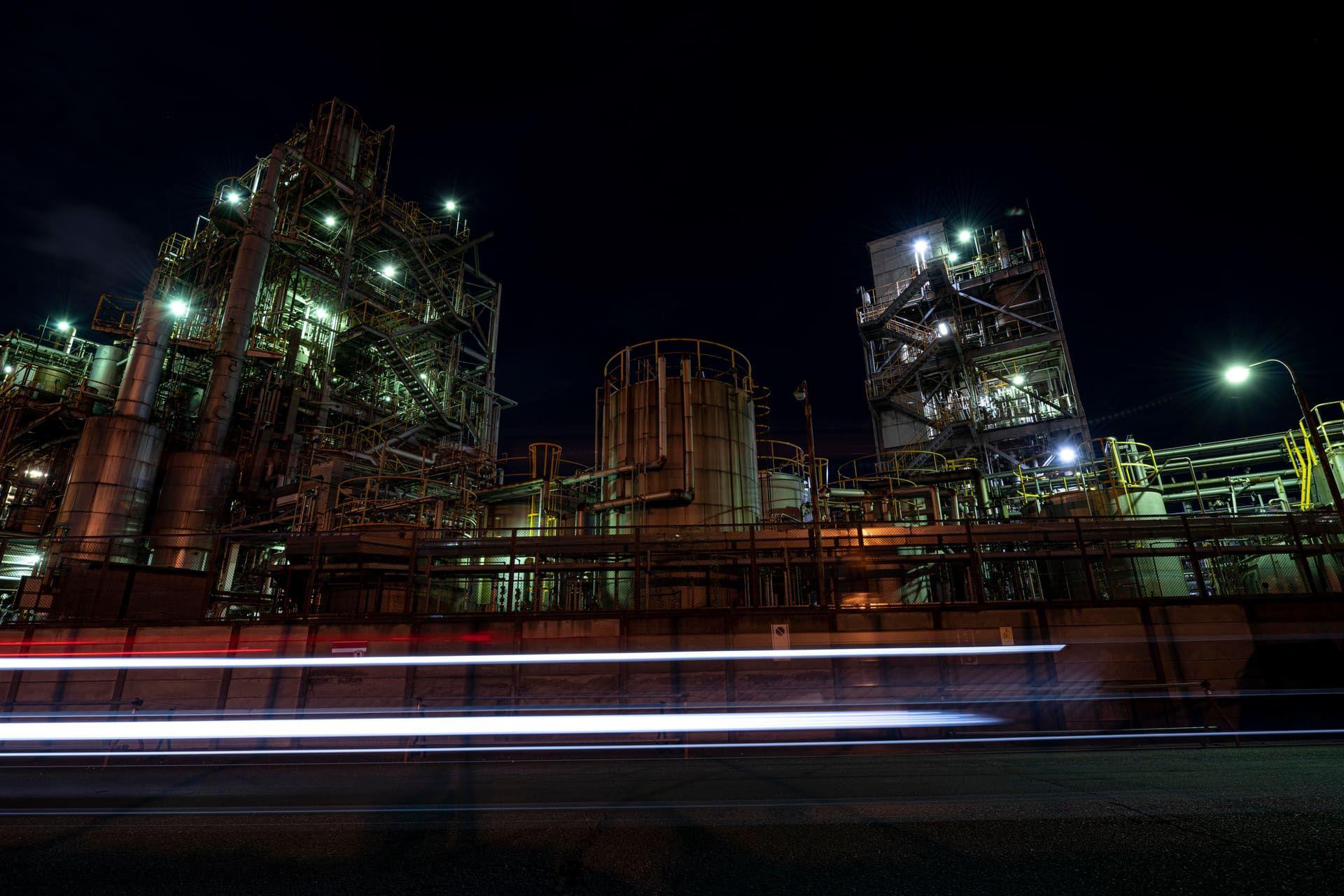
Solvent Recovery Distillation Plant
Part of the Kadali Africa Ventures catalogue. Send your raw material, target product and capacity for a technical proposal. Request a quote →
Product Categories
- Herbal, Botanical & Nutraceutical Extraction(9)
- Essential Oils, Spices & Oleoresins(6)
- Fruit & Vegetable Processing(8)
- Starch, Flour, Edible Oil & Food Processing(7)
- Drying & Dehydration Systems(5)
- Evaporation, Concentration & Solvent Recovery(4)
- Pharmaceutical & Industrial Process Equipment(4)
- Cocoa, Shea, Palm Oil & Oilseed Processing(6)
- Cereals, Tubers & Sugar Processing(6)
- Specialty African Botanical & Natural Ingredients(11)
- Specialty Food, Beverage & By-Product Processing(7)
Talk to Kadali Africa Ventures
Send your raw material, product and capacity for a technical proposal.
Contact Kadali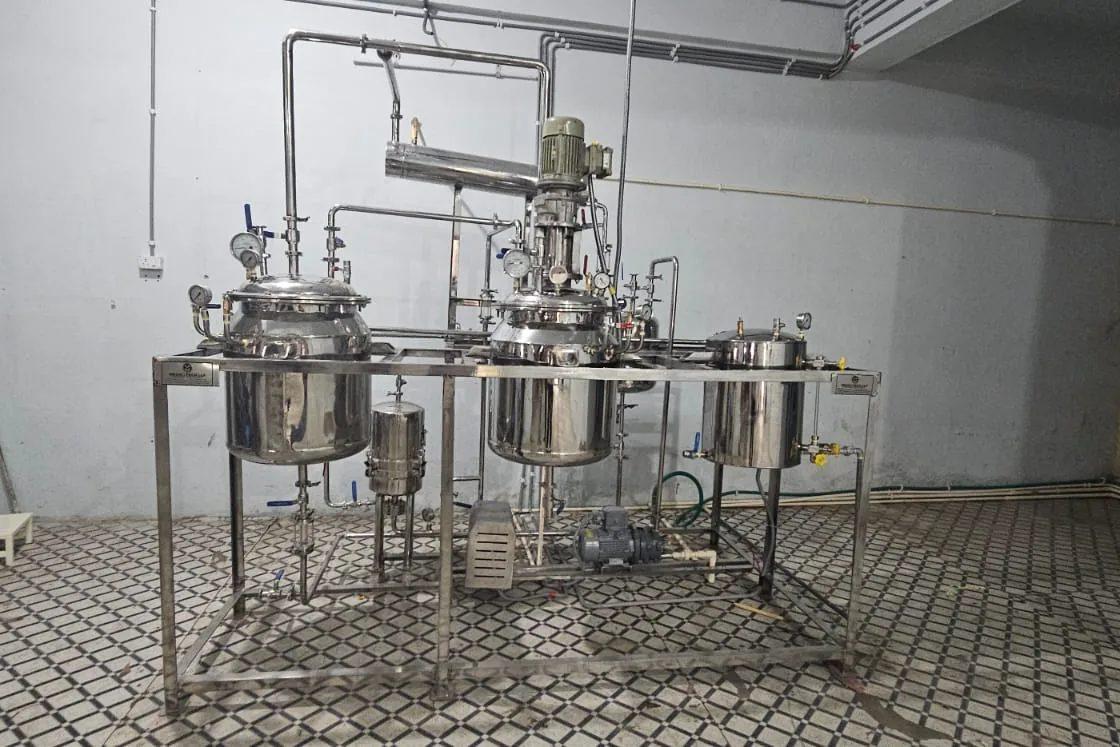
Solvent Recovery Distillation Plant
A solvent recovery plant is for processors who pay for solvent, lose it with every extraction batch and would rather distil it back to a reusable grade than buy fresh stock or pay to dispose of the spent liquid. In African extraction work this usually means ethanol from herbal and botanical extracts, or hexane and acetone from oil, oleoresin and ingredient lines. The questions to settle first are which solvent or mixture is involved, what it carries (water, colour, dissolved extract, solids), what purity it must reach to be reused, how much is handled per day, and what the site can supply in steam, cooling water and electricity. Because ethanol, hexane and acetone are all highly flammable and their vapour and air can form explosive mixtures, the hazardous-area arrangement is part of the plant definition, not an afterthought. The plant is listed as a closed-loop still, condenser and receiver train, engineered once that information is on the table.
Spent solvent that still holds residue is charged to a still and heated, so the solvent boils away from the material that does not vaporise. The vapour then condenses back to liquid in a condenser and is collected in a receiver. A single-stage still is enough when one solvent is being recovered. If two or more solvents must be separated and each returned to its own specification, a column with reflux is added; liquids with close boiling points are hard to separate by distillation, so the number of stages is set in process design. Some mixtures cannot be separated completely by distillation: ethanol and water form an azeotrope, and ordinary distillation can take ethanol only to a purity close to 95 % by weight, so the purity actually needed for reuse should be agreed early. A lower operating pressure lowers the boiling temperature, which is why vacuum is offered for heat-sensitive duties. Flammable duty shapes the whole design: sealed vapour circuit, nitrogen blanketing, flame-proof electrical and instrument items, and vent handling are built in from the start. The still, column where fitted, condenser and receivers are made in SS 316L or another grade suited to the solvent, and a PLC controls heating, vacuum and fraction collection. Scale runs from pilot trials to commercial recovery trains.
Key Specification Inputs
Solvent identity, vapour-liquid balance, hazardous-area classification.
Process Flow
Technical Specifications
| Technology | Closed-loop solvent recovery by distillation of spent process solvent |
|---|---|
| Working Principle | Solvent is boiled off from non-volatile residue, condensed and sent to storage for reuse |
| Arrangement | Single-stage still for one solvent; column with reflux where several solvents must be separated |
| Operating Temperature | Set by the boiling range of the solvent and how heat-sensitive the carried material is |
| Operating Vacuum | Available for heat-sensitive duties and to lower the heating demand |
| Contact Material | SS 316L, or another grade suited to the solvent |
| Safety Design | Flame-proof electrical items, nitrogen or other inert blanketing, and a sealed vapour circuit |
| Recovery Performance | Depends on the solvent stream, how contaminated the feed is and the fraction specification; established in process development |
| Automation | PLC control of heating, vacuum and fraction collection, with batch data logging |
| Capacity | Sized to the requirement, from pilot to commercial scale |
| Utilities | Steam, thermic fluid or electric heating; cooling water, nitrogen, electric power and compressed air |
| Final Output | Reusable process solvent plus a concentrated residue to be disposed of or processed further |
Plant Capacities
| Scale | Typical Duty | Still/Column Configuration | Operating Mode |
|---|---|---|---|
| Pilot | Solvent-recovery process validation | Single-stage still | Atmospheric or vacuum (configurable) |
| Small commercial | Single-solvent recovery for reuse | Single-stage still with condenser | Atmospheric or vacuum (configurable) |
| Commercial multi-solvent | Recovery train splitting two or more solvents | Multi-stage column with reflux | Vacuum-capable for heat-sensitive solvents |
Still or column size, condenser duty and vacuum rating follow from the solvent system, the volume to be handled and the recovery target. The capacity is confirmed during process design, not read off this table.
Typical Process Route
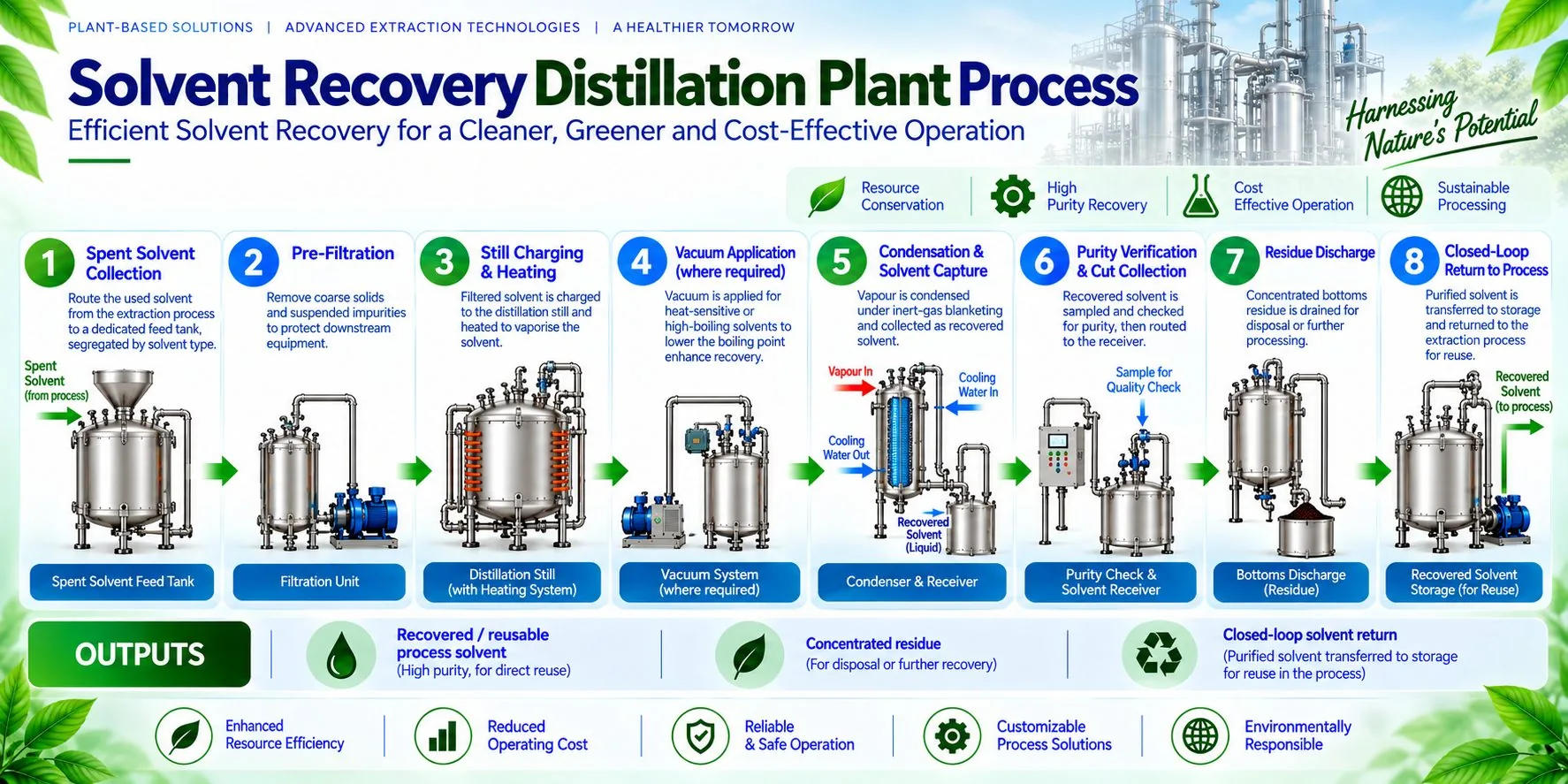
Define Solvent, Feed and Reuse Purity
The first step is on paper: which solvents are present, what they carry, how much is produced per day and what purity the next extraction or washing stage will accept. This fixes the still, the number of stages and the safety class.
Segregating and Collecting Spent Solvent
Streams are kept apart by solvent type and sent to a dedicated feed tank, because mixing different solvents makes recovery harder and lowers the quality of what comes back.
Pre-Filtration
Solids, plant debris or sludge are strained out before the still, so that heating surfaces stay cleaner and fouling is slower.
Charging and Heating the Still
The filtered liquid goes into the still and is heated until the solvent fraction boils off, leaving non-volatile residue and dissolved solids in the vessel.
Vacuum Operation Where Needed
A reduced operating pressure lowers the boiling temperature. This helps with high-boiling solvents and where the residue or the solvent itself should not be held at higher temperature.
Condensing the Vapour
Vapour is condensed in a shell-and-tube condenser within an inert-blanketed circuit, so that little solvent escapes as vapour.
Checking and Cutting Fractions
The distillate is checked against its reuse specification and routed to the matching receiver. Fractions outside the specification are held back for another pass.
Draining the Residue
The thickened residue is drawn off from the base of the still for disposal or further treatment, and the vessel is made ready for the next charge.
Returning Solvent to the Process
Approved solvent goes to storage and back to the extraction, washing or reaction step where it came from, which closes the loop.
Major Plant Equipment
- Feed tank for spent solvent
- Pre-filter or strainer
- Recovery still with reboiler
- Rectification column, where several solvents are split
- Reflux divider and its controls
- Shell-and-tube condenser
- Nitrogen or inert-gas blanketing set
- Receivers for recovered solvent
- Vacuum system for reduced-pressure operation
- Residue collection and drain-off
- Flame-proof electrical items and instruments
- PLC and HMI control panel
Plant Output
Applications
- Recovering ethanol and other extraction solvent for herbal and botanical plants
- Reclaiming washing and rinsing solvent in pharmaceutical process lines
- Recovering reaction solvent in fine-chemical and API work
- Closed-loop handling of flammable solvents such as ethanol, hexane and acetone
- Cutting fresh-solvent purchases and the volume of hazardous waste leaving the plant
- Solvent recovery behind nutraceutical concentrate and standardised-extract production
- Pilot recovery trials before a commercial plant is sized
Key Features
Sealed, Closed-Loop Circuit
Still, condenser and receivers form one enclosed circuit, which keeps vapour losses low and lets recovered solvent return straight to the process.
Built for Flammable Duty
Flame-proof electrical items, nitrogen blanketing and vapour containment are part of the design from the outset, not retrofitted.
One Solvent or Several
A plain still covers single-solvent recovery. Adding a column with reflux allows two or more solvents to be separated and each brought to its own specification.
Vacuum for Sensitive Streams
A lower operating pressure reduces the temperature the solvent and any carried material are exposed to.
Country Pages for Solvent Recovery Distillation Plant
This product is listed on the pages of the countries below, each with its own enquiry route. Where Kadali has no office in a country, enquiries are handled from the Accra office.
Frequently Asked Questions
What should be settled before a solvent recovery plant is specified?
Does the plant need a column, or is a simple still enough?
How is safety handled with flammable solvents?
How much solvent can be recovered?
Does solvent recovery pay for itself?
What drives the energy and cooling demand?
How does this plant relate to other distillation equipment?
What test work should be prepared before sizing?
Is installation and commissioning included?
Ready to discuss your project?
Call or email Kadali Africa Ventures with your raw material, target product and capacity.