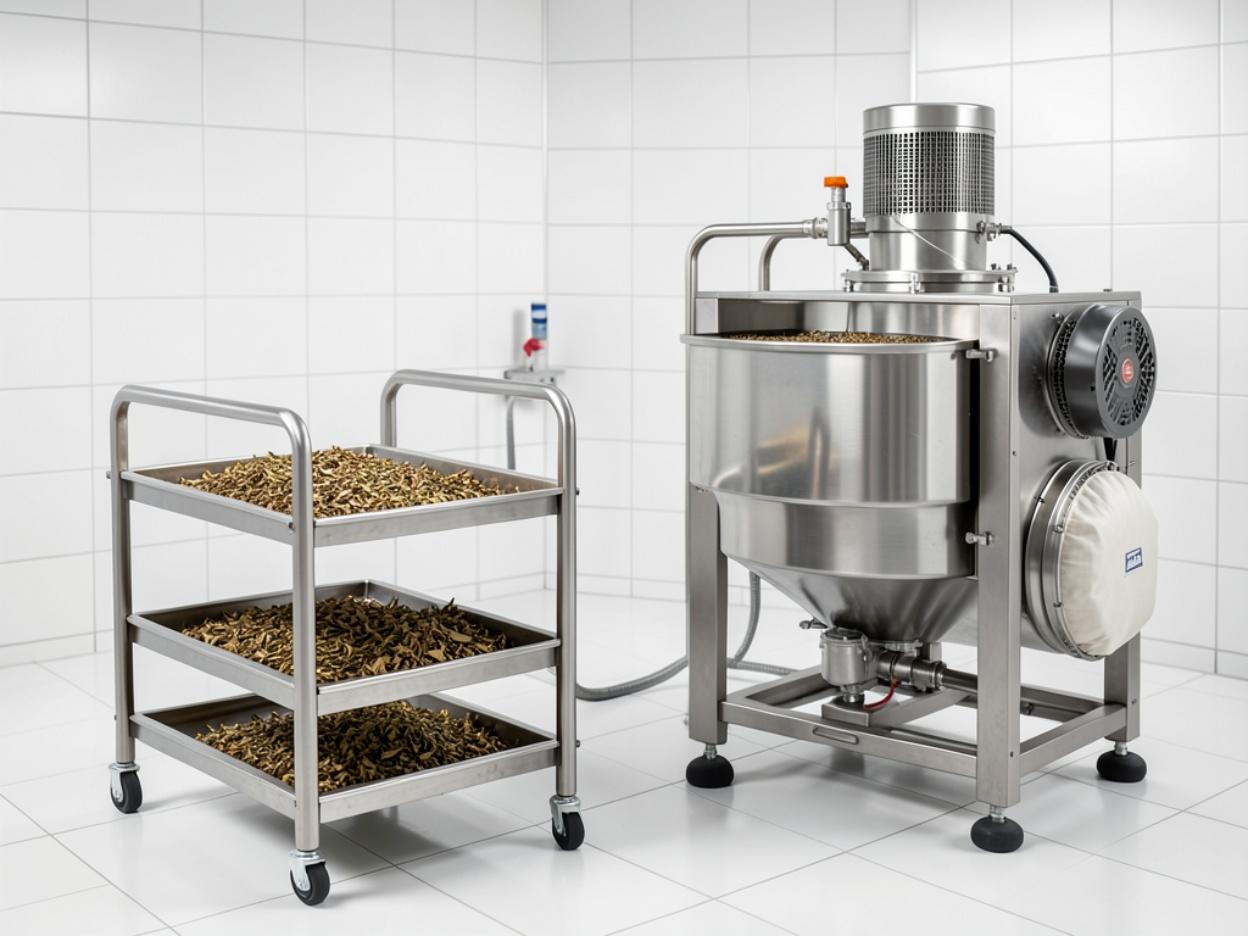
Drying decides whether a product keeps. A processor who loses moisture too slowly risks mould and spoilage, and one who dries too hard or too hot loses colour, aroma and value. The right dryer depends first on what is being dried: slices, leaves, grain, or a liquid that must become a powder. Heat source, local climate and the cost of fuel then narrow the choice further.
This page is for processors of food, spices, herbs and extracts who are choosing a dryer, replacing one or adding drying to a line. It organises the choice by product form, explains the factors that govern drying behaviour and lists the catalogue dryers that relate to each case. The configuration and supply scope for a given dryer are set out in a technical proposal.
What This Service Delivers
- Dryer choice organised by product form and moisture target
- Hot-air, solar-assisted, spray and dedicated food and herb dryers covered
- Heat source and running cost considered with the equipment
- Dust control and product collection included in the module scope discussed
- Parboiled rice and allium dehydration addressed in separate routes
- Supply scope confirmed in a technical proposal
1Start From the Form of the Product
Dryers are grouped by what they accept, so the physical form of the feed usually points to the technology.
- Pieces, slices and whole produce: Fruit and vegetables are dried in chambers or tunnels with controlled hot air, suited to slices, flakes or whole items.
- Leaves, flowers and spices: Light, bulky material that is easily damaged, dried with moderate temperatures and careful airflow.
- Grain and parboiled rice: Dried in bulk, where uniform moisture across the load matters.
- Liquids, slurries and extracts: Converted to powder in a spray dryer, which FAO describes as suitable for fruit-juice concentrates and which is also used for extracts. Liquid foods are normally concentrated before drying, because an evaporator removes water more economically than a dryer.
- Sun-rich locations with limited fuel: Solar-assisted dryers can reduce fuel use where sunshine is reliable and batches are not too large, but an auxiliary heat source is generally advised for reliability and for periods without sun.
2Catalogue Dryers
- Industrial Hot-Air Drying Systems: Feed preparation, a dryer or chamber, heating and air handling, dust control and a collection and packing interface.
- Solar-Assisted Drying Systems: Adds solar heat to the drying system. FAO advises an auxiliary heat source to assure reliability, handle peak loads and keep drying through periods of no sunshine, so the backup depends on the site.
- Spray Drying Plants: For liquid feeds converted into powder, with feed solids and drying conditions central to the design.
- Fruit & Vegetable Dehydration Plants: Slice size, moisture target and heat source govern this route.
- Spice & Herbal Drying Plants: Drying of herbs and spices, as well as extracts that follow extraction.
- Rice Parboiling & Drying Plants: A parboiling and drying route for rice processors.
- Onion & Garlic Dehydration Plants: Dehydration for alliums sold as flakes, granules or powder.
3Moisture, Temperature and Product Quality
- Final moisture target: Set by buyer specification and storage life, this determines how far and how long the product must be dried. Moulds grow on partly dried food, so stopping short is a storage risk.
- Drying curve: Moisture leaves quickly at first and then slowly, so the last few percentage points drive dryer size and time.
- Temperature limit: Many food constituents are sensitive to heat, so FAO describes a compromise between drying rate and quality. High temperature for a short time often does less damage than lower temperature for much longer, which is why the maximum safe temperature and drying time are set together.
- Uniformity: Uneven loading, airflow or slice size leaves wet spots that spoil in storage. Cutting produce into small pieces or thin layers speeds heat and mass transfer, so consistent cut size matters.
- Dust and emissions: Fine powders and exhaust air need collection and control. The UK Health and Safety Executive lists dusts from foodstuffs among dangerous substances, so dust handling should be assessed with your site safety adviser.
4Heat Source and Running Cost
The energy supply often determines whether a dryer is practical at a given location.
- Electricity: Convenient where the supply is dependable and affordable, less so for large duties.
- Steam or thermal fluid: Suits sites that already operate a boiler.
- Biomass or fuel-fired heat: Common where agricultural residue or fuel is available, with attention to clean air and ash.
- Solar assistance: Cuts fuel use in sunny regions but needs a backup for rainy or cloudy days.
- Heat recovery: Reusing exhaust heat can lower running cost on continuous duties.
5What to Tell Us About Your Drying Duty
- Product and form: Name it and say whether it is sliced, whole, leafy or liquid.
- Initial and final moisture: State both and how you measure them.
- Quantity: Give the wet quantity per hour or per day and hours of running.
- Quality limits: Mention colour, temperature or aroma restrictions.
- Local conditions: Describe climate, fuel and power availability, and the floor space.
Frequently Asked Questions
How do I choose between a hot-air dryer and a spray dryer?+
Is a solar dryer reliable enough for a commercial plant?+
What moisture level should I dry to?+
Why does my dried product have wet spots or uneven colour?+
Can one dryer handle several products?+
Which fuel suits an industrial dryer at a remote site?+
Country Pages That Discuss Industrial Drying & Dehydration Solutions
Related Product Categories
Related Products
Enquire About Industrial Drying & Dehydration Solutions
Tell Kadali Africa Ventures about your raw material, target product and capacity, and the technical proposal will set out the scope for your project.