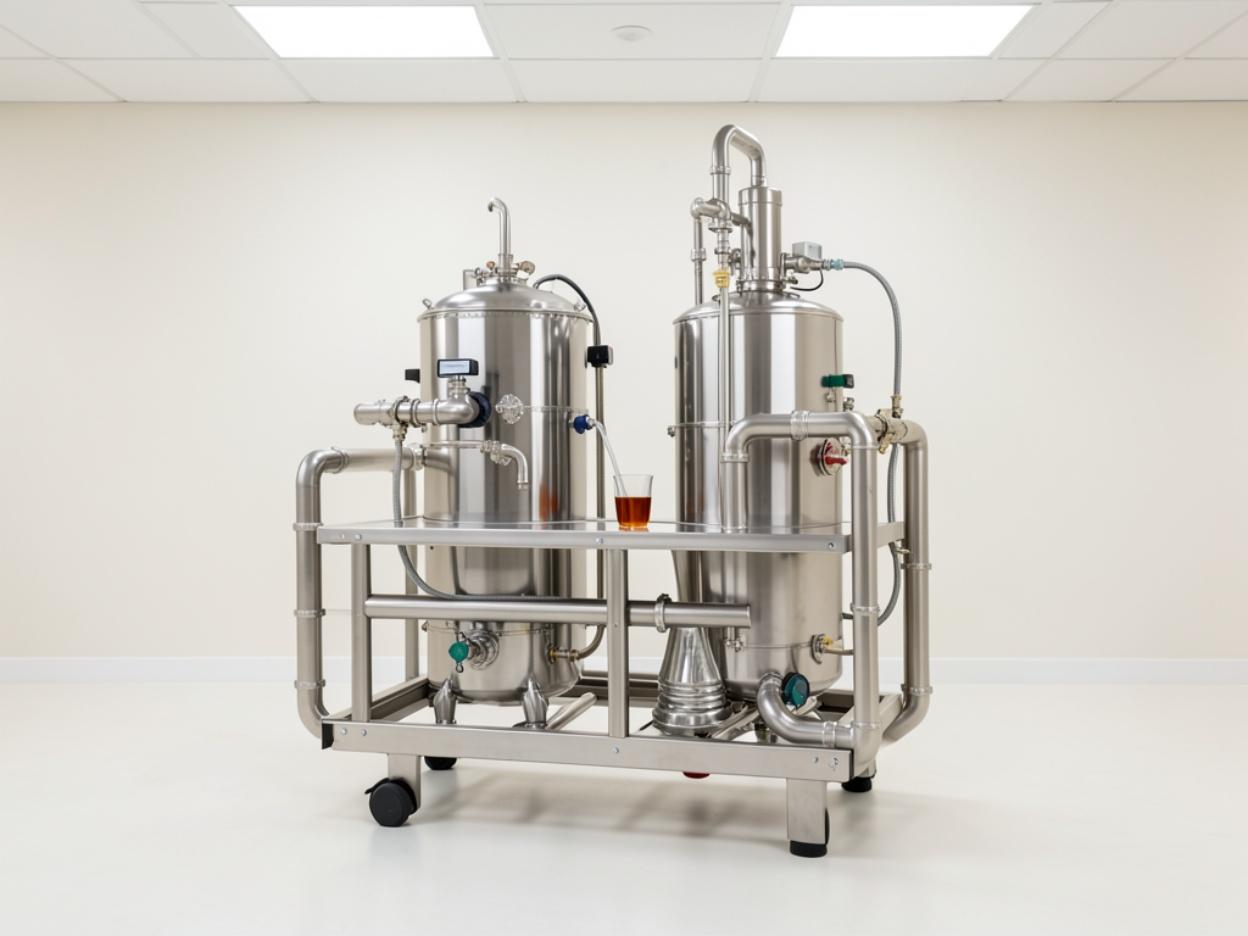
Companies that sell botanical actives to supplement brands or to pharmaceutical buyers are judged on more than yield. Their customers ask for consistent assay, controlled solvent residues, traceable batches and equipment that can be cleaned and documented. A plant that makes a good extract but cannot show how it was made and cleaned may fail an audit, however well it performs.
This page is for ingredient manufacturers, contract extractors and process teams in that position. It explains how documentation and cleanability change plant design, which catalogue equipment relates to curcumin, ginger, aloe and similar actives, and what to define in a user requirement specification before approaching suppliers. Regulatory and quality responsibilities remain with the operator; equipment scope and any documentation package are confirmed in the technical proposal.
What This Service Delivers
- Design features traced to buyer expectations on cleanability and records
- Curcumin, ginger, moringa, aloe and similar actives covered
- Hygienic construction and stainless fabrication in the same enquiry
- Solvent recovery and automation can be scoped alongside extraction
- Requirement-specification checklist to prepare supplier comparison
- Quality responsibility stays with the operator; documentation scope is agreed in the proposal
1Who This Page Is For and What They Make
- Supplement ingredient makers: Producers of standardised extracts such as curcumin, ginger and moringa for capsule, tablet and powder products.
- Pharmaceutical botanical suppliers: Regulated producers of plant-derived actives for medicinal use. In the EU, for example, a full quality dossier is required for every herbal medicinal product, and good manufacturing practice applies to all medicines.
- Contract extractors: Businesses extracting for other brands, who must keep customers' batches apart.
- Aloe, seaweed and olive-leaf processors: Producers whose extracts enter supplement or cosmetic-health markets.
2How Documentation and Cleanability Shape the Plant
These expectations show up in specific design features, which are cheaper to include at the start than to add later.
- Hygienic construction: Smooth, crevice-free, drainable surfaces and stainless wetted parts so product cannot lodge.
- Cleaning approach: Equipment designed to be cleaned between batches, with spray or in-place options where appropriate.
- Material records: Documents showing what the wetted parts are made of and where they came from.
- Instrumentation and records: Measured temperature, pressure and batch records that can support an audit trail.
- Qualification and validation: Procedures to show the equipment installed and operates as specified, with the extent agreed in the proposal.
- Change control: A way to record modifications so the validated state is kept.
3Catalogue Equipment
- Nutraceutical Extraction Plants: Extraction lines where target actives, solvent residuals, assay and drying are the main inputs.
- Pharmaceutical Extraction Plants: Extraction with hygienic design, process validation and regulatory requirements in the specification.
- Curcumin Extraction Plants: Extraction for curcumin, the major yellow-coloured component of turmeric.
- Ginger Extraction Plants: Extraction for ginger actives, such as the gingerols found in ginger oleoresin.
- Pharmaceutical Process Equipment: Process design, fabricated equipment, piping, instrumentation and control panels.
- Stainless Steel Process Equipment: Vessels and equipment made to your pressure, temperature, material and finish requirements.
- Solvent Recovery Plants: Recovery and reuse of solvent from extraction, relevant to residue limits.
- Industrial Process Automation Systems: Control and interlocks that support repeatable batches.
4What to Define in a User Requirement Specification
A written specification helps both sides compare options, and it is a starting point for validation.
- Target compounds and assay method: State the actives, expected content and how they are measured.
- Solvent policy: Say which solvents are allowed and any residue limit your buyers impose.
- Batch definition: Define batch size, how batches are identified and how carry-over is prevented.
- Material of construction and finish: Specify the wetted-part material and surface finish expected.
- Documentation needed: List drawings, material certificates, test records and operating procedures required.
- Controls and data: State what must be measured, alarmed and recorded.
- Room and utilities: Describe the production area, services and classification requirements.
5Typical Projects
- Upgrading a general botanical line: A processor with a basic extractor adds hygienic design and records to supply a supplement customer.
- New ingredient plant: A start-up builds an extraction facility with qualification in mind from the beginning.
- Adding solvent recovery: A plant reduces solvent loss and improves residue control.
- Contract extraction facility: A site that extracts for several clients needs cleaning and changeover capability.
Frequently Asked Questions
What is the difference between a nutraceutical and a pharmaceutical extraction plant?+
Can a plant be guaranteed to meet regulatory requirements?+
Why does stainless steel grade and finish matter?+
How do we control solvent residues in the final extract?+
What is a user requirement specification and do we need one?+
Can an existing botanical extraction line be upgraded for supplement buyers?+
Country Pages That Discuss Nutraceutical & Pharmaceutical Solutions
Related Product Categories
Related Products
Enquire About Nutraceutical & Pharmaceutical Solutions
Tell Kadali Africa Ventures about your raw material, target product and capacity, and the technical proposal will set out the scope for your project.