Stainless Steel Process Equipment
Stainless steel process equipment covers tanks, vessels, piping, valves and frames made in austenitic grades such as 304 and 316L, chosen for the product, the cleaning chemicals and the temperature they must withstand.
Product Categories
- Herbal, Botanical & Nutraceutical Extraction(9)
- Essential Oils, Spices & Oleoresins(6)
- Fruit & Vegetable Processing(8)
- Starch, Flour, Edible Oil & Food Processing(7)
- Drying & Dehydration Systems(5)
- Evaporation, Concentration & Solvent Recovery(4)
- Pharmaceutical & Industrial Process Equipment(4)
- Cocoa, Shea, Palm Oil & Oilseed Processing(6)
- Cereals, Tubers & Sugar Processing(6)
- Specialty African Botanical & Natural Ingredients(11)
- Specialty Food, Beverage & By-Product Processing(7)
Talk to Kadali Africa Ventures
Send your raw material, product and capacity for a technical proposal.
Contact Kadali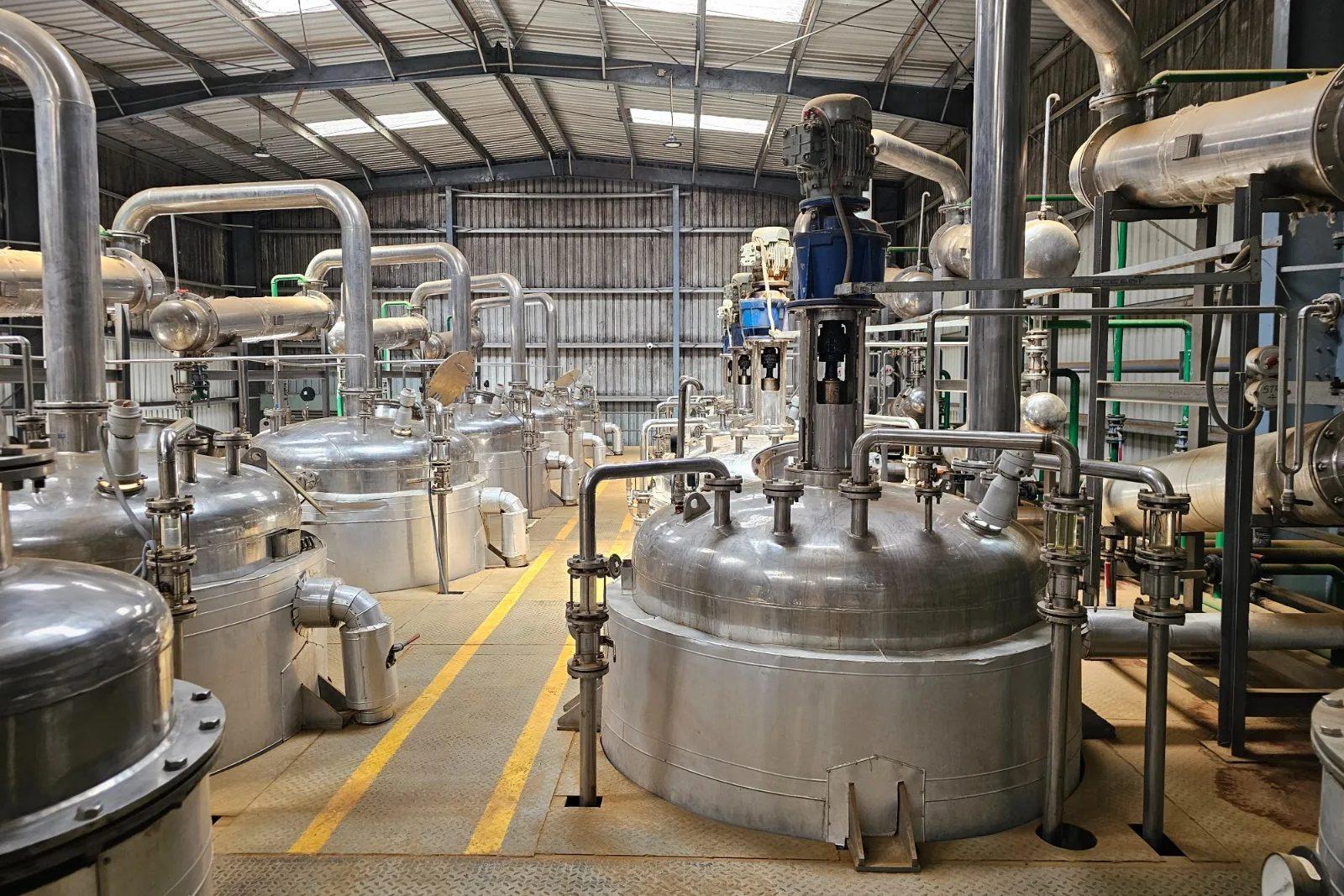
Stainless Steel Process Equipment
The contents are liquids and solids that would rust or contaminate ordinary steel: fruit juice, brine, vegetable oil, herbal extract, milk, process water and caustic or acid cleaning solutions. A buyer should settle what the equipment holds and at what temperature, whether the liquid carries chlorides from salt, brackish water or cleaning chemicals, how it is cleaned, whether the surface must be polished for hygiene or can stay at mill finish, and whether the vessel runs under pressure or vacuum. Those answers fix the grade, wall thickness and finish, and they drive the price, because stainless is bought by weight and each step up in grade or polish adds cost. A proposal should name the exact grade and finish, not just say stainless.
Grade 304 serves most neutral, low-chloride duties. Grade 316 adds molybdenum for better resistance to pitting in chloride environments, and 316L, with its low carbon content, avoids sensitisation in welded parts. Even 316 can pit, crack or suffer crevice attack in hot, salty and stressed service, so a hot brine vessel needs its grade reviewed, and duplex grades are considered for severe duty. Welds matter as much as grade. Product-contact seams are continuous, shielded with inert gas on the inside so that no heat tint forms, and ground smooth, because an intermittent weld leaves a gap where residue collects. After welding, pickling and passivation remove iron contamination and restore the protective chromium oxide film, and the equipment is rinsed with low-chloride water. Surface finish should be stated as a roughness value, not as the word polished. A figure such as 0.8 µm Ra is a common hygienic target for dairy-type surfaces, and electropolishing is an optional extra. Design removes crevices: hollow frame sections are sealed, dead legs in piping are kept short, and tank bottoms slope to a low outlet. Tanks, jacketed vessels, pressure and vacuum vessels and piping each add their own design code and test.
Indicative Capacity Range
- 0.5–20 m³ working volume
Key Specification Inputs
Design pressure, temperature, MOC, finish, applicable codes.
Technical Specifications
| Technology | Fabricated austenitic stainless steel tanks, vessels, piping and structures |
|---|---|
| Grade Options | 304 for neutral, low-chloride duty; 316 or 316L where chlorides, acids or welded product-contact parts call for it; duplex for severe duty |
| Hot Chloride Service | Needs a grade review even in 316, because pitting and stress cracking become risks when the duty is hot, salty and stressed |
| Welding | Continuous welds, inert-gas shielded inside, ground smooth on product-contact seams |
| Surface Finish | Mill finish, ground, polished, bead-blasted or electropolished, set by a roughness value for product-contact surfaces |
| Post-Weld Treatment | Pickling and passivation, rinsed with water low in chloride |
| Design Basis | Atmospheric, jacketed, pressure or vacuum, fixed by design pressure, temperature and the pressure-vessel rules that apply locally |
| Fittings and Connections | Tri-clamp, flanged or welded joints, with sanitary valves, chosen by the cleaning method |
| Frames and Supports | Sealed hollow sections or solid sections, with feet that can be washed round |
| Inspection | Dimensional check, leak or hydrostatic test, and material certificates traceable to the plate |
Typical Process Route
Define Media, Temperature and Cleaning
List every fluid the equipment will meet, with its temperature, chloride content and cleaning chemicals. These fix the grade and the finish before any drawing is made.
Choose Grade and Finish
Choose between 304, 316 or 316L, or duplex for severe duty, and state the surface finish as a roughness value for product-contact areas. Do not specify only the word stainless.
Drawing and Material Selection
Dimensions, nozzles, supports and wall thickness are drawn, and plate and tube are bought with material certificates that trace back to the heat of steel.
Cutting, Forming and Rolling
Plate is cut and rolled into shells and dished ends. Stainless is worked with dedicated tools, away from carbon-steel grinding, because iron dust pressed into the surface starts rust.
Welding
Seams are welded continuously with inert gas inside the joint to prevent oxide. Intermittent welds on product-contact seams leave gaps where bacteria and residue collect.
Grinding and Polishing
Welds on product-contact surfaces are ground flush and polished to the specified roughness, and electropolishing may follow for hygienic duty.
Pickling and Passivation
An acid treatment removes heat tint and free iron and restores the passive film, followed by a rinse in water low in chloride. Skipping this step is the usual cause of early rust spots.
Testing and Inspection
Dimensions are checked, vessels are leak or hydrostatically tested and critical welds can be dye-penetrant tested. Test water is drained and dried, because standing chloride-bearing water pits steel.
Protection, Transport and Installation
Surfaces are wrapped for transport and lifted with non-metallic slings. On site, stainless supports and clean tools keep carbon steel off the surface, and the system is flushed before use.
Process & Equipment Modules
- Process tanks with dished ends
- Jacketed or insulated vessels
- Agitated mixing vessels
- Pressure and vacuum vessels
- Hygienic pipework and fittings
- Valves and manifolds
- Pumps with stainless wetted parts
- Hoppers, tables and conveyors
- Structural frames, platforms and ladders
- Clean-in-place spray balls and return lines
Plant Output
Applications
- Fruit juice, pulp and syrup holding and blending tanks
- Edible oil storage and process vessels
- Herbal extract and solvent-contact vessels
- Milk, beverage and brewery-type process tanks
- Brine and salt-bearing duty in 316L
- Hygienic pipework and valve manifolds for liquid food
- Cleaning-solution and process-water tanks
- Tables, hoppers, conveyors and platforms for food-contact handling
Key Features
Grade Named for the Duty
304, 316L or duplex is stated for each part of the plant, so quotations can be compared on steel and not only on weight.
Continuous Welds, Ground Smooth
Inert gas protection inside the joint and a smooth finished seam keep product-contact welds free of gaps and heat tint.
Finish Stated as a Number
A roughness value on the specification gives the fabricator and the inspector the same target, and polish is paid for only where the product needs it.
Passivation After Welding
Pickling and passivation restore the protective film after fabrication, and a low-chloride rinse protects it.
Crevice-Free Design
Hollow sections are sealed, gasket seats are clean and piping avoids long dead legs, since crevice geometry can matter more than the chloride level.
Drainable Geometry
Sloped bottoms and low outlets let tanks and lines empty fully, which helps cleaning and keeps standing water off the steel.
Related Products
Frequently Asked Questions
What information is needed to size Stainless Steel Process Equipment?
What capacity range does Stainless Steel Process Equipment cover?
When is 304 enough, and when is 316L needed?
Which media attack stainless steel?
What should a specification state for surface finish?
What should a specification say about welds on product-contact seams?
What does passivation do, and can it be skipped?
What drives the price of stainless steel equipment?
How do I request a proposal for Stainless Steel Process Equipment?
Enquire about Stainless Steel Process Equipment
Send your raw material, target product and capacity to Kadali Africa Ventures for a technical proposal.