Spray Dryer
Part of the Kadali Africa Ventures catalogue. Send your raw material, target product and capacity for a technical proposal. Request a quote →
Product Categories
- Herbal, Botanical & Nutraceutical Extraction(9)
- Essential Oils, Spices & Oleoresins(6)
- Fruit & Vegetable Processing(8)
- Starch, Flour, Edible Oil & Food Processing(7)
- Drying & Dehydration Systems(5)
- Evaporation, Concentration & Solvent Recovery(4)
- Pharmaceutical & Industrial Process Equipment(4)
- Cocoa, Shea, Palm Oil & Oilseed Processing(6)
- Cereals, Tubers & Sugar Processing(6)
- Specialty African Botanical & Natural Ingredients(11)
- Specialty Food, Beverage & By-Product Processing(7)
Talk to Kadali Africa Ventures
Send your raw material, product and capacity for a technical proposal.
Contact Kadali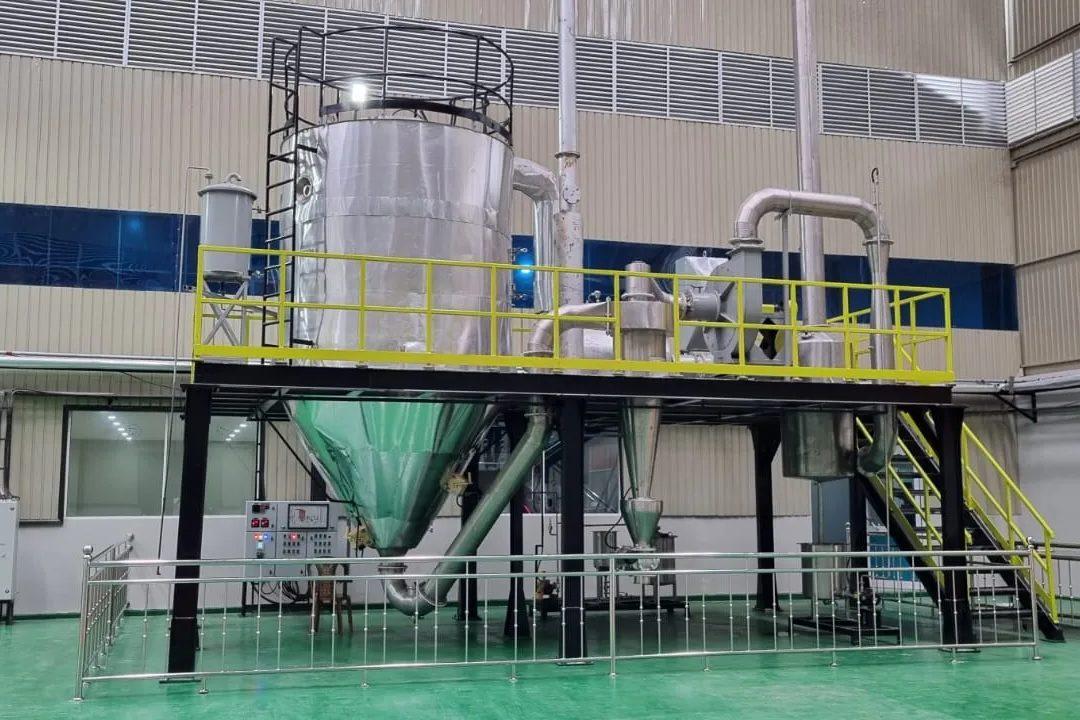
Spray Dryer
A spray dryer is the plant to consider when a processor already has, or intends to make, a pumpable liquid such as a botanical extract, a fruit-juice concentrate or an ingredient slurry and needs it as a dry powder that stores, packs and ships more easily. In African agro-processing the feeds that usually lead to this question are herbal and spice extracts, hibiscus and moringa extracts, and fruit or vegetable concentrates. Several points have to be settled before a dryer can be sized: how much water must be evaporated each hour, the temperatures the product will tolerate, whether a carrier may be added, and the moisture and particle size the buyer expects. The plant is listed as a complete train, from feed tank through to sieved powder, with each stage configured after those inputs are known.
The drying chamber is a cylinder over a conical base, fabricated in SS 316L or another grade that suits the product, with electropolished surfaces wherever product touches metal. Liquid is broken into droplets by an atomiser, either a high-speed rotary disc or a pressure or two-fluid nozzle. The properties of the powder depend on the feed (viscosity, particle size and flow rate), the drying-air temperature and the type of atomiser, so the atomiser is chosen against feed viscosity and the particle size wanted, and confirmed on a trial. Heated air enters through a disperser at the top, and air and droplets move co-current or counter-current according to how much heat the product tolerates. Water evaporating from a droplet draws heat from it and cools it, and drying is quick, so many heat-sensitive extracts can be dried without prolonged heat exposure; higher inlet temperatures can still darken or degrade sugar-rich powders. Dry particles drop to the base, and the exhaust, still carrying the finest powder, goes to a cyclone and/or bag filter before it is released or partly recycled. Juice and extract powders rich in sugars and acids have a low glass transition temperature and can stick to the chamber wall, so a carrier or drying aid such as maltodextrin is commonly added to give a free-flowing powder. A PLC regulates feed rate, atomisation and inlet and outlet air temperatures, the chamber and cyclone can be cleaned in place, and the scale ranges from trial units for formulation work to commercial production dryers.
Key Specification Inputs
Drying curve, moisture targets, temperature limits, emissions.
Process Flow
Technical Specifications
| Plant Type | Spray drying plant: liquid or slurry is atomised into a stream of hot air to give powder |
|---|---|
| Chamber and Contact Parts | SS 316L, or another grade suited to the product; electropolished where product touches metal |
| Atomising Method | High-speed rotary disc, or pressure or two-fluid nozzle, chosen against feed viscosity and the particle size wanted |
| Air and Product Flow | Co-current or counter-current, set by how much heat the product can tolerate |
| Drying-Air Heating | Steam, thermic fluid, electric or gas-fired heater, according to the energy source available on site |
| Powder Recovery | Cyclone and/or bag filter capture the fines carried in the exhaust air |
| Chamber Shape | Cylindrical body over a conical base with powder discharge at the bottom |
| Feed | Liquid, slurry or concentrate; a carrier or drying aid is optional |
| Particle-Size Levers | Atomiser type, its speed or pressure, and the drying-air temperature |
| Powder Handling | Collection from the chamber base and the cyclone or bag filter, then sieving or sifting |
| Controls | PLC regulation of feed rate, atomisation, and inlet and outlet air temperature |
| Cleaning | Chamber and cyclone arranged for clean-in-place |
| Capacity | Sized from the water to be evaporated, from pilot-scale spray dryers to larger commercial units |
| Utilities | A heat source for the air heater (steam, thermic fluid, electricity or gas), compressed air and electric power |
Plant Capacities
| Dryer Scale | Typical Use | Atomiser Type | Evaporation Duty |
|---|---|---|---|
| Pilot-scale | Formulation & particle-characteristic trials | Rotary disc or nozzle | Low, configurable |
| Production-scale | Commercial powder manufacturing | Rotary disc or nozzle | Medium-to-high, configurable |
| Large production-scale | High-throughput continuous powder lines | Rotary disc or nozzle | High, configurable |
Chamber diameter, heater duty and atomiser choice follow from the water content of the feed and the evaporation rate required. Throughput is fixed only once the feed and the finished-powder specification are known, ideally after a trial.
Typical Process Route
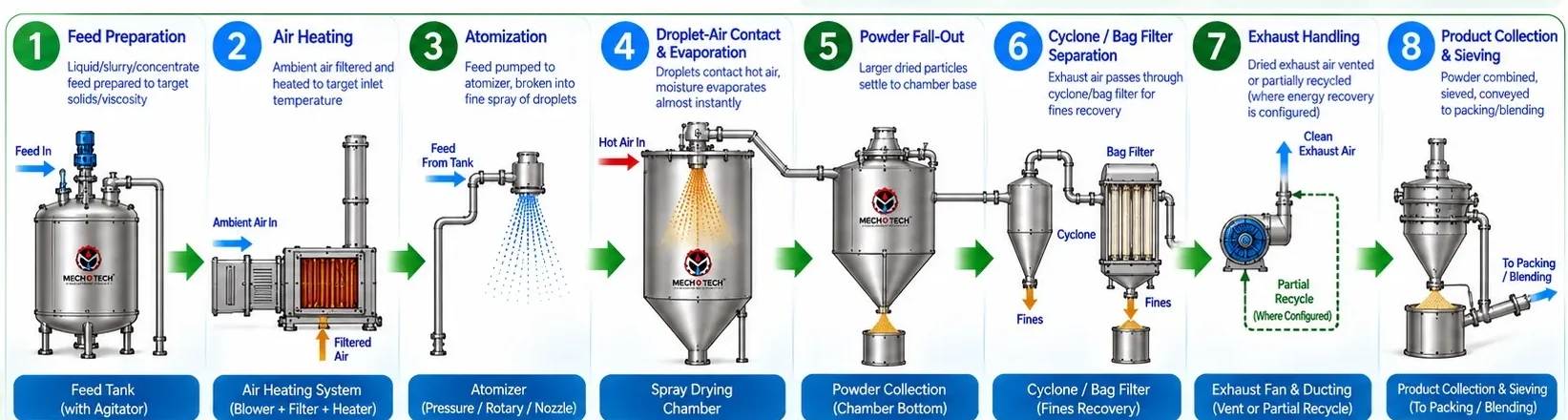
Agree the Feed and Powder Targets
Before anything is built, the feed solids, viscosity, heat limits, wanted moisture and particle size, and the acceptability of a carrier are written down. These inputs decide the atomiser, air flow pattern and chamber size.
Feed Preparation
The liquid, slurry or concentrate is brought to the intended solids and viscosity and filtered or screened to protect the atomiser. A carrier or drying aid is blended in where the product is sticky, and the batch waits in an agitated feed tank.
Heating the Drying Air
Ambient air is filtered and warmed in a direct or indirect heater, using steam, thermic fluid, electricity or gas as configured, until it reaches the set inlet temperature and passes into the chamber through the disperser.
Atomisation
A pump delivers the feed to a rotary disc or a pressure or two-fluid nozzle, which turns it into a fog of fine droplets. Atomiser type and operating settings are matched to the particle-size distribution the buyer needs.
Drying in the Chamber
Droplets meet the hot air in co-current or counter-current flow. Fine droplets have a very large combined surface area, so water leaves quickly and each droplet becomes a dry particle.
Powder Discharge
The heavier particles settle into the conical base and are discharged to the handling system, while the lightest remain suspended in the exhaust air.
Capturing the Fines
Exhaust air passes through a cyclone and/or bag filter that removes the suspended fine powder and leaves a cleaner air stream.
Exhaust Treatment
After final filtration, the air is vented or, where heat recovery is configured, partly returned to the process.
Sieving and Collection
Powder from the base and from the filter is combined, sifted to remove oversize lumps and sent to packing or to a blending step.
Major Plant Equipment
- Drying chamber with conical base, SS 316L and electropolished
- Atomiser: rotary disc, or pressure or two-fluid nozzle
- Air heater using steam, thermic fluid, electricity or gas
- Hot-air disperser at the chamber top
- Agitated feed tank and feed pump
- Cyclone separator
- Bag filter for fines recovery
- Exhaust blower and ducting
- Powder discharge and conveying
- Sieve or sifter for oversize lumps
- Sensors for inlet and outlet air temperature, feed rate and atomiser speed or pressure
- PLC control panel with recipe storage
Plant Output
Applications
- Powdering concentrated botanical and herbal extracts
- Fruit and vegetable juice powders from concentrates, subject to a feed trial
- Nutraceutical and dietary-supplement ingredient powders
- Instant beverage, dairy-type and flavour powders
- Encapsulation of flavours and fragrances in a carrier matrix
- Enzyme, probiotic and other biological powders where heat limits allow
- Colourant, pigment and specialty-chemical powders
- Protein and functional-ingredient powders
Key Features
Liquid to Powder in One Pass
Atomising the feed and drying it in hot air in one continuous step turns a pumpable liquid directly into powder, with no separate grinding of a dried cake.
Brief Heat Exposure
Water evaporating from each droplet cools it, and the drying time is short. For many heat-sensitive extracts this makes spray drying workable, though suitability should be confirmed on the actual feed, since higher inlet temperatures can darken sugar-rich powders.
Adjustable Particle Properties
Particle size, bulk density and flow behaviour can be tuned through the atomiser, its speed or pressure and the air conditions, within the limits of the feed.
Steady Continuous Output
Feed goes in and powder comes out without stopping, which suits lines that need a regular daily tonnage more than batch-by-batch cycles.
Fines Recovery and Dust Control
Cyclone and/or bag-filter separation recovers fine powder that would otherwise be lost with the exhaust, helping both yield and emission control.
Country Pages for Spray Dryer
This product is listed on the pages of the countries below, each with its own enquiry route. Where Kadali has no office in a country, enquiries are handled from the Accra office.
Related Products
Frequently Asked Questions
Who should consider a spray dryer, and what should be decided first?
How does a short drying time protect heat-sensitive extracts?
Rotary disc or nozzle: how is the atomiser chosen?
What preparation does the feed need in a warm climate?
What drives the energy use of a spray dryer?
Can a sticky or hygroscopic product be spray dried?
When is freeze drying preferred to spray drying?
What safety points apply to powder-producing plants?
What should be prepared for a technical proposal?
Ready to discuss your project?
Call or email Kadali Africa Ventures with your raw material, target product and capacity.