Frankincense Extraction Plant
Part of the Kadali Africa Ventures catalogue. Send your raw material, target product and capacity for a technical proposal. Request a quote →
Product Categories
- Herbal, Botanical & Nutraceutical Extraction(9)
- Essential Oils, Spices & Oleoresins(6)
- Fruit & Vegetable Processing(8)
- Starch, Flour, Edible Oil & Food Processing(7)
- Drying & Dehydration Systems(5)
- Evaporation, Concentration & Solvent Recovery(4)
- Pharmaceutical & Industrial Process Equipment(4)
- Cocoa, Shea, Palm Oil & Oilseed Processing(6)
- Cereals, Tubers & Sugar Processing(6)
- Specialty African Botanical & Natural Ingredients(11)
- Specialty Food, Beverage & By-Product Processing(7)
Talk to Kadali Africa Ventures
Send your raw material, product and capacity for a technical proposal.
Contact Kadali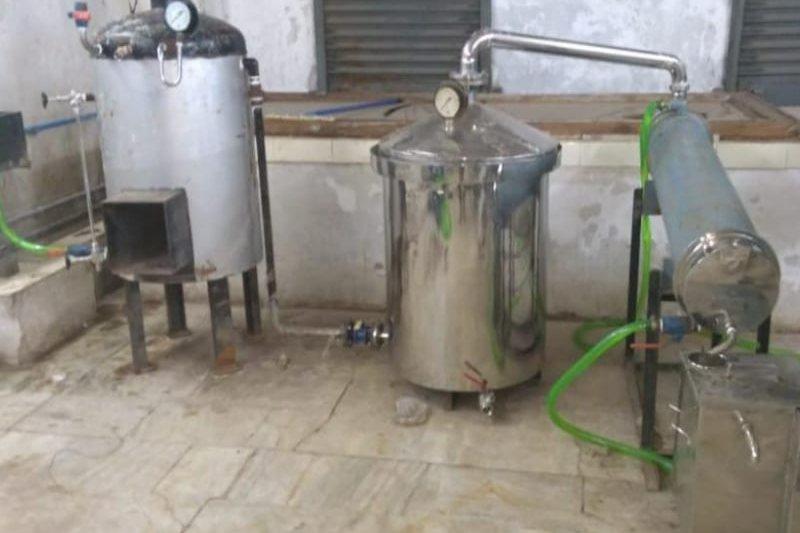
Frankincense Extraction Plant
Frankincense is the dried oleo-gum-resin of Boswellia trees, tapped as hardened tears in the dry woodlands of East Africa and the Sahel belt, among other regions. A processor weighing up a plant has one question to answer first: which product will the buyer pay for? An aromatic essential oil, a base-note resinoid or absolute, and a boswellic-acid powder for supplements come from three different process trains, and none is a setting on another. The tear is mostly not oil: Boswellia papyrifera tears are about 3-8% volatile oil, 60-70% alcohol-soluble resin and 27-35% water-soluble gum, so the oil route works on a small fraction of the tear and the solvent routes on a much larger one. This page is written for fragrance and incense suppliers, herbal-ingredient makers and resin aggregators who now sell raw tears and want to add value locally, and it sets out what to decide before a plant is sized.
Start with the feedstock. Tears can arrive with bark, grit and dust from tapping and bagging, so every route begins with sorting, cleaning and size reduction. After that the routes split. The water route uses steam or hydro distillation in a stainless still, a chilled condenser and an oil-water separator, and gives oil plus a hydrosol; resin needs a long run, and Boswellia sacra distillate has been collected in fractions over many hours. The solvent routes use closed jacketed extractors, filtration, vacuum evaporation and solvent recovery, and end as a resinoid or, with purification and drying, as a powder. Wetted parts are SS 316L. Final configuration depends on the feedstock, the product specification and the capacity.
Indicative Capacity Range
- 100–2,000 kg resin/day
Key Specification Inputs
Resin grade, volatiles vs nonvolatiles, distillation/extraction.
Technical Specifications
| Routes covered | Distillation to an essential oil, or solvent extraction to a resinoid or to a boswellic-acid extract |
|---|---|
| Feedstock | Hardened Boswellia tears from tapping; species (for example B. papyrifera, B. sacra (syn. B. carteri) or B. serrata) to be confirmed for every sourcing lot |
| Essential oil route | Steam or hydro distillation of cleaned, milled resin; the oil is checked by GC-MS profile and physical parameters and is not sold on boswellic-acid content |
| Resinoid route | Closed, jacketed SS 316L extractors using a food-grade alcohol or hydrocarbon solvent chosen for the target product, giving a resinoid or absolute |
| Boswellic-acid route | Temperature-controlled solvent extraction followed by purification; Boswellia serrata extract grades run from 30% to 85% boswellic acids by titration, including AKBA-enriched |
| Front end | Resin reception, cleaning and sorting, then controlled milling |
| Distillation train | SS 316L still, multi-tube condenser on chilled-water circulation, stainless Florentine flask, then polish filtration and drying |
| Solvent train | Filter press or pressure leaf filter, cartridge polishing, falling-film or vacuum evaporator and a closed solvent-recovery loop |
| Wetted material | SS 316L, designed for CIP cleaning |
| Controls | PLC-based; PLC-SCADA with recipe handling on the extraction routes |
| Flammable solvents | Areas handling solvent on the resinoid route are engineered for flammable duty |
| Capacity basis | Set to the requirement; because resin varies by origin, species and season, capacity is fixed only after a pilot trial |
Typical Process Route
Receive, Grade and Clean the Resin
Incoming tears are checked for species, size, colour and age, then cleaned of bark, sand and other debris collected during tapping and bagging.
Size Reduction
Clean tears are crushed or milled to a controlled particle size. Particle size, feed rate and any cooling needed during milling are settled in the trial on your own resin.
Distillation Route: Charging and Steaming
For essential oil, the milled charge goes into the SS 316L still and is steam- or hydro-distilled. The mode and run length are settled in the pilot trial, and resin generally needs a long run, many hours.
Distillation Route: Condense and Separate
Vapour is condensed in a multi-tube condenser on chilled water. The oil is drawn off in a Florentine flask, and the aromatic water is kept as a hydrosol co-product.
Distillation Route: Filter, Dry and Test
The raw oil is polish-filtered and dried, and each batch is tested by GC-MS profile and physical parameters before it is released.
Solvent Route: Extraction
For a resinoid or boswellic-acid extract, milled resin is extracted in closed jacketed SS 316L vessels at controlled temperature, usually through several cycles because the resin matrix is dense.
Solvent Route: Clarify, Concentrate and Recover
The resin-bearing liquid is clarified by filtration and cartridge polishing, then concentrated under vacuum. Solvent is condensed and returned through the closed recovery loop.
Standardise, Purify and Finish
A resinoid is assayed and adjusted to its declared specification. On the boswellic-acid route the concentrate is purified, vacuum-dried and pulverised, and released only after residual-solvent, heavy-metal, microbial and moisture tests.
Major Plant Equipment
- Resin receiving, cleaning and sorting station
- Resin crusher or controlled-milling unit
- SS 316L still configurable for steam or hydro distillation
- Multi-tube condenser fed by chilled water
- Stainless Florentine flask for oil-water separation
- Oil polish-filtration and drying station
- Closed jacketed SS 316L extraction vessels
- Solvent storage tanks with transfer pumps
- Filter press or pressure leaf filter, with cartridge polish filters
- Falling-film or vacuum evaporator
- Closed-loop solvent recovery with condensers and vacuum pumps
- Vacuum tray dryer or spray dryer plus pulveriser for the powder route
- Clean-in-place (CIP) skid
- PLC panel, motor control centre and field instruments
Plant Output
Applications
- Essential oil for aromatherapy, perfumery and fragrance compounding
- Resinoid as a base-note ingredient in fine fragrance
- Incense and traditional resin-based products
- Boswellic-acid extract for joint-health and anti-inflammatory supplements
- Aromatic and active ingredients for cosmetics and skin care
- Raw material for Ayurvedic, Unani and other traditional preparations
- Standardised ingredient supply to pharmaceutical manufacturers
Key Features
Resin-Specific Front End
Sorting, cleaning and milling are set up for hard, dusty tears with bark and sand attached, which is a different handling job from leaf, flower or seed.
Three Products, Three Trains
Oil, resinoid and boswellic-acid powder are not interchangeable. Boswellic acids are high-molecular-weight compounds, so a distilled oil is not a boswellic-acid product.
Oil Released on Analytical Data
Each distilled batch is judged against its GC-MS profile and physical parameters, and a certificate of analysis can accompany it.
Long-Cycle Solvent Extraction
Time and temperature are configured for the dense resin matrix, and a closed loop returns recovered solvent for reuse.
Adjustable Distillation
Distillation mode and run length can be adapted to the hardness and volatile content of different Boswellia sources.
Country Pages for Frankincense Extraction Plant
This product is listed on the pages of the countries below, each with its own enquiry route. Where Kadali has no office in a country, enquiries are handled from the Accra office.
Related Products
Frequently Asked Questions
Which should I make first: essential oil, resinoid or boswellic-acid extract?
Why will distilled frankincense oil not meet a boswellic-acid specification?
How should tropical-climate resin be prepared before it reaches the plant?
Which Boswellia species do African origins offer, and does it matter?
What decides solvent and energy use on these routes?
Which solvents can be used for the resinoid route?
Does the plant scope include tapping, collection or grading?
What sample and trial work should come before a proposal?
Can one plant also handle myrrh or other resins?
What should a quotation request contain?
Ready to discuss your project?
Call or email Kadali Africa Ventures with your raw material, target product and capacity.