Pharmaceutical Process Equipment
Pharmaceutical process equipment is the vessels, filters, dryers, piping and controls used to make a regulated botanical or pharmaceutical ingredient, built so that every product-contact part can be cleaned, checked and documented.
Product Categories
- Herbal, Botanical & Nutraceutical Extraction(9)
- Essential Oils, Spices & Oleoresins(6)
- Fruit & Vegetable Processing(8)
- Starch, Flour, Edible Oil & Food Processing(7)
- Drying & Dehydration Systems(5)
- Evaporation, Concentration & Solvent Recovery(4)
- Pharmaceutical & Industrial Process Equipment(4)
- Cocoa, Shea, Palm Oil & Oilseed Processing(6)
- Cereals, Tubers & Sugar Processing(6)
- Specialty African Botanical & Natural Ingredients(11)
- Specialty Food, Beverage & By-Product Processing(7)
Talk to Kadali Africa Ventures
Send your raw material, product and capacity for a technical proposal.
Contact Kadali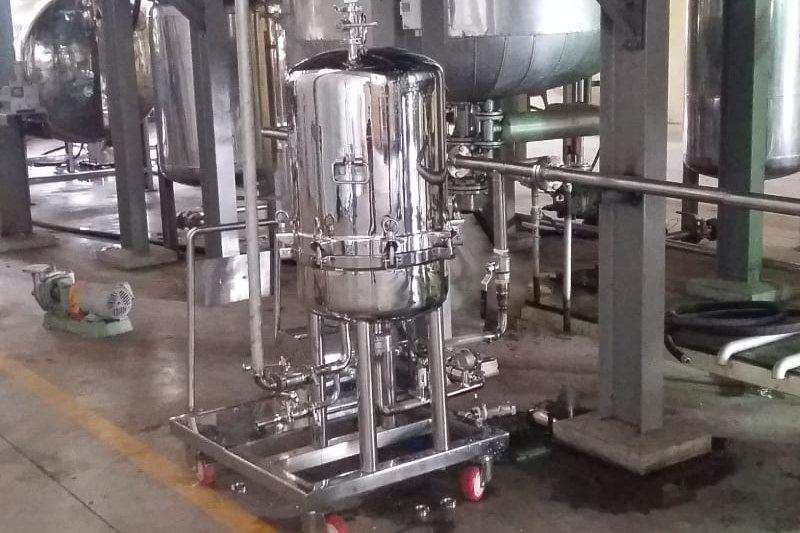
Pharmaceutical Process Equipment
The feed is normally dried plant material or a chemical intermediate, and the product is an extract, intermediate or ingredient that the customer will test against a written specification. Before equipment is chosen, a buyer needs to settle the product and batch size, the solvent, which parts touch the product, whether one train will make several products in turn, how it will be cleaned between batches and what documents the customer's own quality system will ask for. Those answers decide the materials, finish, dedicated parts, instrument layout and control specification, and they drive the price more than vessel volume does. The page covers the whole equipment train rather than a single machine; a complete plant for pharmaceutical extraction is a separate page.
The usual train follows the extraction route. Plant material is milled to a controlled size and extracted in a jacketed, agitated vessel, where solvent, temperature and time are set by recipe. A filter press, nutsche filter or centrifuge removes the spent material, a vacuum evaporator concentrates the liquid and recovers solvent, and a purification step is added only where the specification needs it. A vacuum dryer, filter-dryer or spray dryer finishes the product, chosen by heat sensitivity and the powder form wanted. What makes the equipment pharmaceutical is mostly design detail. Contact surfaces are smooth and drainable, with short dead legs and no pockets that hold residue. Gaskets and seals are named by material and duty. Instruments sit where they can be isolated and checked without opening the process. The controller carries user access levels so that recipes and set points change only through authorised people. Parts that are hard to clean, such as filter cloths and bags, are often kept for one product. Validation follows from a written user requirement, so that drawings, material certificates, weld and test records and the software are judged against the same document.
Indicative Capacity Range
- 50–2,000 kg dry feed/day
Key Specification Inputs
Process validation, materials, hygienic design, regulatory requirements.
Technical Specifications
| Technology | Batch processing of botanical or pharmaceutical ingredients: extraction, separation, concentration, drying and solvent recovery |
|---|---|
| Contact Material | SS 316L, or a higher grade where the solvent or an acid wash demands it |
| Surface Finish | Smooth, drainable internal surfaces, with electropolishing chosen for vessels that cannot be dismantled for cleaning |
| Cleaning Method | Manual, spray-ball clean-in-place or both, decided by how often the product changes |
| Dedicated Parts | Filter cloths, bags, gaskets and seals reserved per product where cleaning is difficult |
| Extraction Vessel | Jacketed and agitated, with temperature control and a condenser, sized to the batch |
| Separation Options | Filter press, nutsche filter or centrifuge, chosen by solids load and solvent |
| Drying Options | Vacuum tray dryer, filter-dryer or spray dryer, chosen by heat sensitivity and powder form |
| Instrumentation | Temperature, pressure, flow and weight devices fitted so they can be isolated and checked |
| Control System | PLC with user access levels, protected set points, and recipe and batch logging |
| Utilities | Steam or hot water, cooling water, vacuum, compressed air and power, with purified water where the process needs it |
Typical Process Route
Raw Material Inspection
Incoming plant material or intermediate is sampled against the written specification for identity, moisture and foreign matter, and each accepted lot is coded so that every batch can be traced back to it.
Cleaning and Sizing
Material is sieved, destoned and milled to a controlled particle size, which sets extraction rate and filtration behaviour. Mill dust is contained, and the milling area is kept apart from the extraction hall.
Controlled Extraction
A jacketed, agitated vessel holds solvent, temperature, time and ratio to the recipe, with protected set points and recorded batch data. A closed vessel with a condenser keeps solvent losses low.
Solid-Liquid Separation
A filter press, nutsche filter or centrifuge takes the spent material out of the liquid. Filter cloths and bags are hard to clean fully, so many users reserve them for a single product.
Concentration and Solvent Recovery
A vacuum evaporator raises the solids at a low boiling temperature, which protects heat-sensitive compounds, while the condensed solvent goes back to storage for reuse. Foaming and fouling are the usual troubles.
Purification (if needed)
Adsorption resin, crystallisation or a membrane step removes unwanted compounds when the specification demands it. Each addition brings extra vessels, solvent or buffer streams and a waste route.
Drying
A vacuum dryer, filter-dryer or spray dryer brings the product to its target moisture. The choice follows heat sensitivity, powder properties and how much containment the product needs.
Packing and Batch Records
Dried product is discharged into lined containers, sampled and labelled, and the batch record, with set points, times, alarms and weights, is assembled for the customer's own release decision.
Process & Equipment Modules
- Milling and sieving unit for plant material
- Jacketed extraction vessel with agitator
- Filter press or agitated nutsche filter-dryer
- Centrifuge for solid-liquid separation
- Vacuum evaporator with condenser
- Solvent recovery still
- Adsorption or crystallisation vessel
- Vacuum dryer or spray dryer
- Product-contact piping with hygienic fittings
- Calibration and isolation points on instruments
- PLC and HMI panel with user levels
- Discharge and packing station
Plant Output
Applications
- Standardised plant extracts for herbal medicine and capsule makers
- Concentrated intermediates for further purification elsewhere
- Dried extract powders for tablet and capsule filling
- Purified single-compound fractions such as glycosides or alkaloids
- Pilot batches for process development and trial scale-up
- Multi-product extraction suites that change product between campaigns
Key Features
Smooth, Drainable Contact Surfaces
Vessels slope to a low outlet, welds are ground flush and dead legs are kept short, so residue has nowhere to sit and cleaning can be written as a procedure.
Dedicated Parts Decided Early
Filter cloths, bags and some gaskets are hard to clean and are often kept for one product. Counting them, and their spares and storage, belongs in the specification.
Instruments You Can Check
Temperature, pressure, flow and weight devices are fitted with isolation and test points, so calibration needs no dismantling of the process.
Controlled Recipe Access
User levels and protected set points let only authorised people change recipes, and batch data is kept for each run.
Documentation Written Into Scope
Drawings, material certificates, weld and test records and the instrument list are listed in the proposal, so validation work by the buyer has material to start from.
Related Products
Frequently Asked Questions
What information is needed to size Pharmaceutical Process Equipment?
What capacity range does Pharmaceutical Process Equipment cover?
What makes this equipment pharmaceutical rather than ordinary process equipment?
Should filter cloths, bags and gaskets be dedicated to one product?
Is one extraction train enough for several products?
How is the control software judged?
Who can change a recipe or set point in the control system?
How should instruments be arranged for calibration?
How do I request a proposal for Pharmaceutical Process Equipment?
Enquire about Pharmaceutical Process Equipment
Send your raw material, target product and capacity to Kadali Africa Ventures for a technical proposal.